second chance games

Search This Website of delight

Showing posts with label Near East. Show all posts

  Sword & Siege Crusades: Book II by Wargame Design Studio   Wargame Design Studio is at it again. I am a little late to the party. It w...

Sword & Siege Crusades: Book II by Wargame Design Studio Sword & Siege Crusades: Book II by Wargame Design Studio

For your Wargamer, Toy soldier collector, MiniFig collector, military history nut. Reviews, interviews, Model Making, AARs and books!

Near East


Sword & Siege Crusades: Book II


by


Wargame Design Studio


  Wargame Design Studio is at it again. I am a little late to the party. It was released a few months ago, but better late than never. You have so many famous rulers in this time frame of the Crusades. Frederick I Barbarossa, Saladin, and Richard I Coeur de Lion - also called Malik Rik by his Muslim opponents (supposedly by saying Malik Rik they would frighten their children to behave). In this game you also get the rather unsettling Fourth Crusade and its conquering of Constantinople. Apparently, none of the Crusaders had a compass and landed just a little astray. As an extra added attraction, you get probably the most famous Siege of Acre included (it had quite a few). It was included in the 'Art of Sige' by SPI and was one of my favorite board wargames. This is what WDS has to say about the game:

"Crusades: Book II" is the second title in a planned trilogy documenting the Crusades launched against the Levant over several hundred years.


In the mid-12th century, the eastern Mediterranean was a complex region of competing powers. The Latin crusader states, though wealthy in ports and castles, were short on manpower. The Roman (Byzantine) Empire, a Christian great power, had its own strategic priorities and a history of lost provinces. The Muslim world, while not unified, was increasingly capable of consolidating resources under strong rulers in Syria and Egypt. Warfare was constant, influenced by both politics and piety, with alliances shifting and control of strategic locations often more important than holding empty land.


“Crusades: Book II” picks up after the Second Crusade’s failure outside Damascus in 1148. The Crusader forces abandoned the siege due to supply issues, conflicting goals, and mistrust among allies. The Levant was left with a frontier society, the Latin states of the Holy Land, which were rich in sacred significance but lacked manpower. These states aimed to maintain their territories, secure routes, and expand influence where possible.


The early period of this era was marked by vulnerability in the north. The first battle in 1149 at Inab saw Nur al-Din defeat the Principality of Antioch’s army and kill its prince, highlighting the fragility of the crusader frontier. The Latin East was not a unified “Crusader Kingdom” but a collection of lordships—Jerusalem, Antioch, and Tripoli—each with its own priorities and rivalries. Cooperation was possible but not guaranteed, and a concentrated enemy force could turn a local defeat into a broader crisis.


From the 1150s to the 1170s, the strategic landscape shifted as Muslim power consolidated. Nur al-Din’s expansion in Syria escalated the conflict from border raids to a struggle for regional dominance. The Crusader states retained strengths such as formidable castles, access to the sea for supplies and reinforcements, and the ability to attract periodic aid from Europe. However, these advantages could be undermined if an opponent could choose the time and place of battle, coordinate multiple armies, and maintain pressure on several fronts.


The rise of Saladin marked a major turning point. Emerging from the politics of Egypt and Syria, he unified resources previously divided between rival courts to wage a more coherent war. This led to a growing ability to concentrate forces and apply pressure to the Crusader states’ weakest points. In 1187, the Frankish field army was defeated at Hattin, followed by the rapid loss of inland strongpoints, most notably Jerusalem. Even where garrisons held out, the strategic balance had shifted: the crusader presence could survive but no longer dominate.


This crisis led to the Third Crusade (1189–1192), notable for its scale and for figures such as Richard I, Philip II, and Frederick Barbarossa. It also highlighted a recurring theme in Book II—crusading involved logistics and coalition warfare as much as battlefield courage. Western armies had to transport men, horses, and supplies across seas and hostile coastlines, coordinate large forces from different realms, and convert tactical victories into lasting control. Coastal strongholds like Acre were crucial as ports, depots, and gateways, but inland dominance required field armies that the Latin states struggled to maintain year after year.


The years after 1192 marked the era's challenging middle, characterized by raids, sieges, and relief marches through towns, castles, and along connecting routes. The crusader states, now focused on coastal cities and fortifications, had to defend supply lines and prevent enemy armies from isolating strongpoints. Their opponents faced operational challenges, such as assembling forces over long distances, coordinating commanders, and sustaining pressure through repeated campaigns. This period saw the strategic balance tested directly by who could seize, hold, and relieve key positions.


From this unstable equilibrium emerged the Fourth Crusade, intended to strike eastward but ultimately remembered for a catastrophic diversion. The decisive factors were practical rather than ideological: fleets, transport capacity, and the ability to deploy an army where needed. Entangled in Byzantine internal struggles and supported by Venice, the crusading force turned against Constantinople. In April 1204, the city fell and was sacked, shocking contemporaries and reshaping the balance of power in the eastern Mediterranean.


Between 1149 and 1204, the background covered in Book II is a story of momentum and miscalculation: how a frontier society tried to survive in a hostile landscape, how its opponents learned to coordinate and concentrate, how charismatic leaders and hard geopolitics could turn containment into reconquest, and how grand plans of kings could be derailed by money, weather, and temptation. If Book I ended with disappointment outside Damascus, Book II shows the subsequent long struggle to endure between crusade and counter-crusade, culminating in a finale that transforms the eastern world even as the original goal slips further out of reach.


The region where the game’s battles unfold encompasses the modern-day territories of Israel, Gaza, the West Bank, Jordan, Lebanon, Syria, parts of Turkey, and Iraq. This area has been a theater of nearly 3,300 years of continuous warfare, spanning from the Battle of Kadesh (dated to 1274 B.C., the first battle to be recorded with significant detail) to the present-day conflicts.


Crusades: Book II includes 102 Scenarios – covering a variety of sizes and situations, including a solo tutorial scenario, five Training scenarios, Historical, Variant and What If versions for both head to head play and vs. the computer AI.

A range of maps are included covering all the significant locations fought over during the 3rd & 4th Crusades, the period between the 2nd and 3rd Crusades and some of lesser known locations.

The order of battle files cover the various forces that participated in the campaigns with other formations added in for hypothetical situations.

There are extensive 3d unit graphics covering all of the major armies involved.

Campaign and Scenario Editors which allow players to customize the game.

Sub-map feature allows the main maps to be subdivided into smaller segments for custom scenario creation.

Design notes which cover the production of the game, campaign notes and a bibliography that includes the sources used by the design team to produce this historical simulation game.

Crusades: Book II provides multiple play options including play against the computer AI, Play by E-mail (PBEM), LAN & Internet "live" play as well as two player hot seat.

Includes battles from all aspects of the 3rd & 4th Crusades + period between 2nd & 3rd Crusades - major encounters to small skirmishes. 102 stand alone scenarios and 4 campaigns. A sampling would be:

Inab
Ascalon
Lake Huleh
Butaiha
al-Buqaia
Harim
Bilbeis
al-Babein
Alexandria
Montgisard
Damietta
Hama
Jacob's Ford
Kerak Castle
Hattin
Jerusalem
Tyre
Safed
Acre
Arsuf
Constantinople"


 Thank you WDS, for once again charging into the breach.


 Cradle of Civilization Includes Two Games: Sumeria to Persia & Alexander vs. Darius by Compass Games     The ancient Near and Middle Ea...

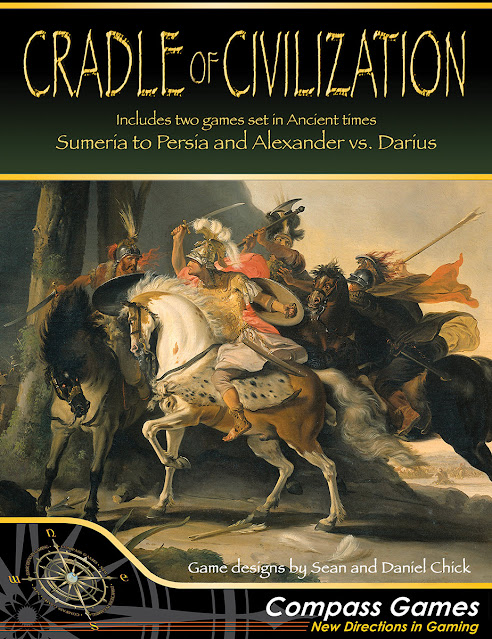
Cradle Of Civilization by Compass Games Cradle Of Civilization by Compass Games

For your Wargamer, Toy soldier collector, MiniFig collector, military history nut. Reviews, interviews, Model Making, AARs and books!

Near East


 Cradle of Civilization


Includes Two Games:


Sumeria to Persia

&

Alexander vs. Darius

by

Compass Games


 The ancient Near and Middle East had a deep and centuries long history. Three of the West's largest religions had their birth there. The first law codes were written down and implemented there. The area had two of the four places around the world where civilization started to flourish first. It is pretty amazing to think that Cleopatra is closer to us than the people who built the pyramids. 


 So, Compass Games has bitten off a lot with two games in one box. We are used to having two games using the exact same rules in one box, but this is different. They have a civilization building game that goes from Sumeria to the Persian Empire. Then there is a totally different game about Alexander's successful attempt to conquer the Persian Empire. The first is listed as easy to medium on difficulty, and the second is listed as medium difficulty.


 I will tackle the Alexander game first. You have to read the designer's notes to understand the game. Their belief that Alexander's winning is not the cut and dried outcome that most have been taught. They think that Darius III had a good shot at beating Alexander except for getting some bad breaks. The worst of these was the death of his general Memnon very early in the contest. Memnon did not, unlike the Persian Satraps (governors), want to battle it out with Alexander. He wanted to use a Fabian type strategy against him. Memnon knew that in a straight up battle between the two forces the Macedonians would win. What he wanted to do was attack Greece with the huge Persian Navy, then always shadow Alexander and try to cut him off from home and getting supplies. In this game you get to see if it would have worked.


 The other game, Sumeria to Persia, is an altogether different  beast. Compass Games always knows where my armor is thinnest. I am a wargamer at heart, and they will have to hit a home run for me to get interested in this kind of game. I have played more than a few of this genre on a board or on the computer, but none so far has been able to keep my interest. So, let us see how they do. The Map board is the same for both games, and the counters only differ in what is pictured on them. Therefore, my assessment of the components will be done together. 


 This is the official Compass Games take on the two games:


Components:

One mounted map (22 X 34 inches)

Nine full sheets of large 0.65” counters

Two rules booklet

Six player reference cards

Forty-Eight Nation/City/Epoch tiles

Twelve 6-sided dice

One box and lid set

Complexity: 2 out of 10 (Sumeria to Persia), 4 out of 10 (Alexander vs. Darius)

Solitaire Suitability: 1 out of 10 (Sumeria to Persia), 7 out of 10 (Alexander vs. Darius)

Players: one to six

Playing Time: 3 hours


Game Credits:

Designers: Sean and Daniel Chick

Artists: Bill Morgal and Shane Hebert


 The box is both heavy and large. It is the size and girth of a game that delights us gamers to open. Of course, you should never judge a book by its cover. However, we all do it. We love to spread out all of the box's contents and glory over it like a dragon over its hoard. 

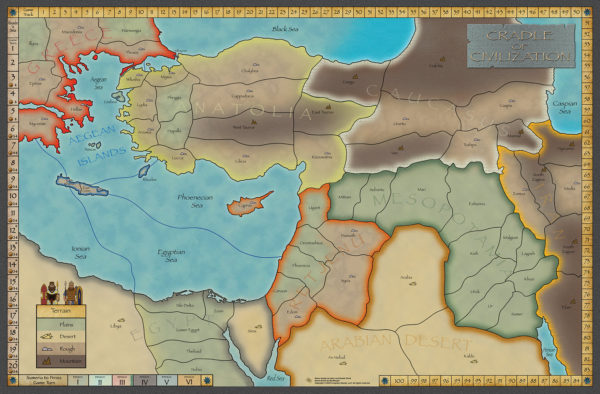
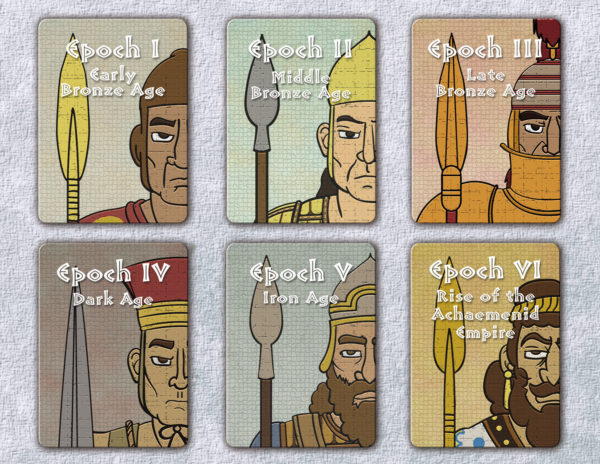
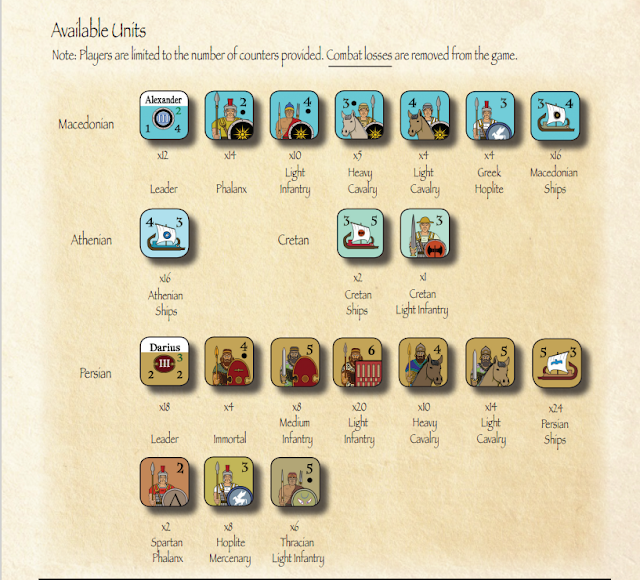
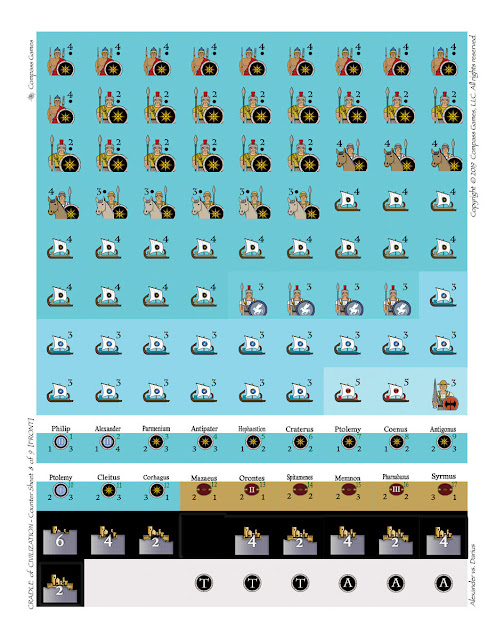
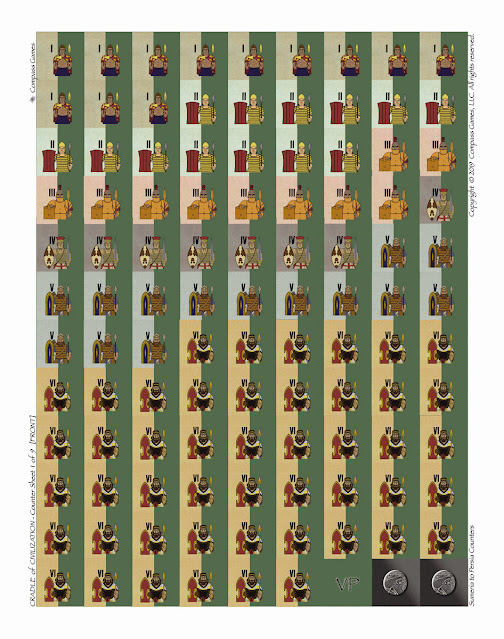
 As you can see above, the mounted map goes from Macedonia to the eastern parts of modern Iran. It folds out completely flat the first time you spread it out. The map is also very sturdy, so it should last through many games. Its colors are easy on the eyes, and still make it easy to see the different areas on it. It is subdivided for area movement instead of hexes. The counters have beautiful pictures on them. They are also large, and they come with the corners already clipped. As far as thickness, these are some of the thickest counters I have ever held. These are very easy to read and see even with old eyes. Now we come to the cards, or should I say clay tablets. The cards are the same thickness as the counters! I assume that they were made to look and feel like millennial old clay tablets. If that is what they were striving for, then Compass Games hit the nail on the head. If you sharpened the edges of the cards you could have some useful shurikens. The game comes with four sets of Player Aids: Two different ones for both Alexander vs Darius, and Sumeria to Persia. These are done in very hard stock, and could be easily used to swat flies. The writing is in large print and the sheets are colorful. Both games have their own Rulebooks. Alexander vs Darius Rulebook is twenty pages long. The rules are only nine pages long. The rest is taken up by the setups, Events Table, and the Designer Notes etc. Sumeria to Persia Rulebook is also twenty pages long. The rules for this game run a little over nine pages. A small write up about each culture in the different Epochs (there are six of them) makes up the rest of the Rulebook. As far as components, Compass Games has hit it out of the park. 


 These are two tidbits from the Designer Notes:

 "The idea for this game was born out of a moment of gaming frustration. In all my readings and studies on history and 
warfare I’ve found at least one historical truth: war is messy and its outcome uncertain. Alexander the Great is always held 
in such a certain esteem among military historians for his bravery and daring. He pulled off one of the most ambitious 
invasions in history and succeeded. His victory over the Persian empire is stunning in its entirety. Yet, Alexander’s victory 
is almost seen as inevitable. Persia is in disarray. Darius lacks military skill and daring. The Phalanx is dominate in the 
field. Therein lies a contradiction: How is Alexander’s victory over Persia simultaneously a great military endeavor and 
inevitable?

The design of this game was kept simple and accessible in order for it to be picked up quickly. The design of the battles 
are also kept simple, but also very bloody in its losses. I wanted a game that was fast enough to make sure almost every 
decision you make matters and must be weighed carefully but not too carefully. Playing it too safe will not win you the 
game. I hope I have succeeded in doing that and I also hope you enjoy this game.
As Alexander himself said “I am not afraid of an army of lions led by sheep; I am afraid of an army of sheep led by a lion.”


 I love, worship, and adore Ancient Wargames, and I have noticed exactly what the designer has. Alexander's Uncle went so far as to say, " I have fought men and Alexander faced women" (when he invaded Italy). However, I still accept the "great men" thesis of history. What happens if it wasn't Darius III on the Persian throne, or if Memnon hadn't died from illness? This is an excellent game to find out. It is also fast paced, so you can try more than one strategy on game night, or even have a few more games. The rules are simple to learn, while still giving you the flavor of the war. You also get to play with the world beating Phalanx, and Persian Cavalry (which if handled correctly could have given Alexander a run for his money). I think it says a lot that Alexander wanted to seem to be a legitimate King of Kings in the Persian Empire's eyes, and not just some barbarian usurper. He adopted almost everything of the Persian customs, and this is what probably got him killed (if not a pickled liver). Alexander vs Darius is fun even playing on the losing side. The Events Table adds a certain doubt in your mind for every move you make. This is the Sequence of Play of the game:

The game is divided into 20 turns. These turns represent 
each season over a 5 year period. Each player will take 
turns taking certain actions during these turns. The number 
of actions you can take will depend upon the amount of 
treasure you have to spend.

Phases
1. Generate Treasure
2. Take Actions Until Both Players Pass
3. Supply and Recruitment
4. Spartan Rebellion (Starting turn 3)
5. Maintain Armies and Navies 


 These are some of the events that you can get on the Event Table die roll:

Crete Aids Alexander
Illyrian Raids
Egypt in Revolt
Persian Court Intrigue
Poris Invades
Scythian Raids

 You will have to deal with rules about these and other subjects:

Sieges
Force March
Leaders
Out of Supply Armies
Maintaining Your Forces


 Sumeria to Persia is a different game. Here is Mr. Chick again with some designer notes about it:

"Sumeria to Persia is an update of sorts to the mechanics of History of the World, adding rules for wonders, colonization, 
and old civilizations still enjoying steady growth. The system, without modification, breaks down a bit with the Neo-Assyrian and Persian Empires. Both were massive. Indeed, Neo-Assyria enjoyed two periods of particularly robust growth, 
while Persia all but covered the map by the time the Persians were defeated at Marathon. The answer was to have both 
periods of Assyrian growth simulated, while Persia would cover only Cyrus the Great’s conquests. The Persian army is 
large, but its growth is erratic, making the choice of Persia a calculated risk. Any player who is behind will want them, but 
that is no guarantee of victory."

 This is the games sequence of play:

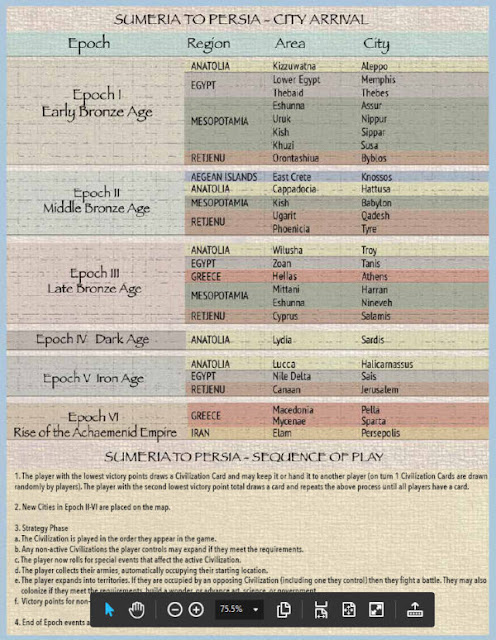
The game is played in six Epochs (or Turns). Each Epoch is 
divided into three phases:
 1) New Civilization Allocation Phase
 2) Strategy Phase
 - Player Civilization Rounds
 - Player Scoring
 3) End of Epoch Phase

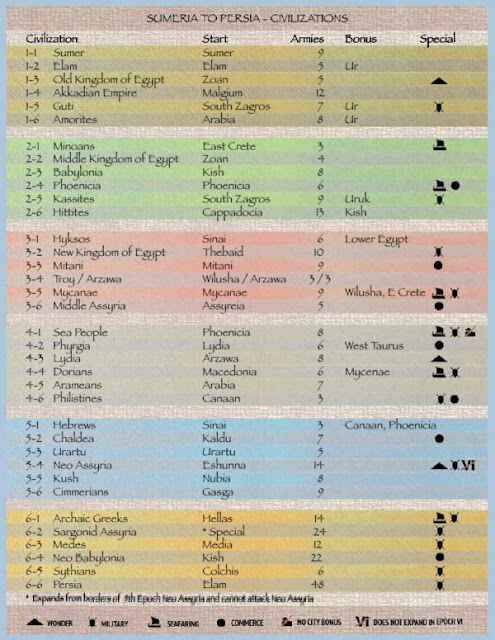
Sumeria to Persia was not really the type of game I thought it would be. It does have civilization growth and fall in it. However, it is also a game about conquering territory, which is right up my alley. My favorite part about the game is its sheer scope. I have seen games that had ancient Egypt, Babylon, and Israel in them as playable. have you ever seen a game where you could play the Mitanni? Here is a list of some of the nations/city states that you can play:

Sumer 
Elam 
Old Kingdom
Akkadian Empire
Minoans
Hittites
Hyksos
Mycenae
Troy
Assyria
Sea People
Urartu
Archaic Greeks

 Besides conquering, you also get Victory Points for building a Wonder, colonization, and advancing your culture. To try and build a Wonder you must take one of your armies out of play and challenge the fates with a die roll. 

 Once again, Compass Games has taken me to a place I never really had interest in before playing this game. Then they didn't just take me there, but ensured I had fun doing so. 


 Naturally, because of my wargaming bias, I prefer to play Alexander vs Darius. That is not to say that Sumeria to Persia is not a good game. The Epochs that it represents, especially the early ones, I am extremely interested in from a history point of view. How the 'Land of Two Rivers' became so important to the budding world is great stuff. Thank you, Compass Games for allowing me to review both of these games. I was very interested when I found out Sean Chich was one of the designers. I have a good number of his other games, and I felt with him you cannot go wrong, at least so far. On the games' websites below you can read both of the Rulebooks of the games. Peruse the site at your leisure. I have a ton of their games, and am in the queue for a good many more. 

Robert

Cradle of Civilization:

Compass Games:

While you are at Compass Games check these two upcoming games:


I am drooling over both of them.


hpssims.com