second chance games

Search This Website of delight

The Space 4X, it calls to strategy gamers like a siren song, leading game developer after developer to take a stab at creating ...

Astra Exodus Astra Exodus

For your Wargamer, Toy soldier collector, MiniFig collector, military history nut. Reviews, interviews, Model Making, AARs and books!


The Space 4X, it calls to strategy gamers like a siren song, leading game developer after developer to take a stab at creating "the" definitive space 4X to rule them all. Some games stick to the Master of Orion 2 model and try to further refine it, while others branch out into new directions, but most bill themselves as being something new and innovative. That's practically a necessity in a world where we've seen dozens of new space 4X titles come and go in the past decade. Astra Exodus is taking a bold step by intentionally labeling itself as a "retro-inspired" strategy game that will remind you of the older classics, with a splash of the new, and a hefty dose of pixel art and a color palette that screams 90's fashion. Seriously, this game is not afraid of being colorful.


Now, if you've had your fill of MoO 2 style games over the years and aren't interested in another take on that kind of game, Astra Exodus is probably not going to do anything for you. However, I imagine there is a sizable audience out there that finds the likes of Stellaris and Galactic Civilizations III to be a bit overwhelming, with endless mechanics, charts, and menus to sort through. Maybe you are indeed looking for something very akin to the classics, but with some modern spice in the mix. Astra Exodus may be just the thing for you. 


Astra Exodus is a single-player only affair, with two ways to play. There is the standard sandbox mode where you can pick one of 8 different factions and try to dominate the galaxy, or the story campaign where you will lead humanity in their quest to learn more about their past and the exodus from Earth. The campaign serves as something of a tutorial, starting you off with very small maps and weak opponents, and gradually cranking up the heat. Like the majority of 4X games, the story serves well enough as window dressing for the various scenarios, but isn't particularly riveting. The primary draw of the game will of course be the more open sandbox mode. 


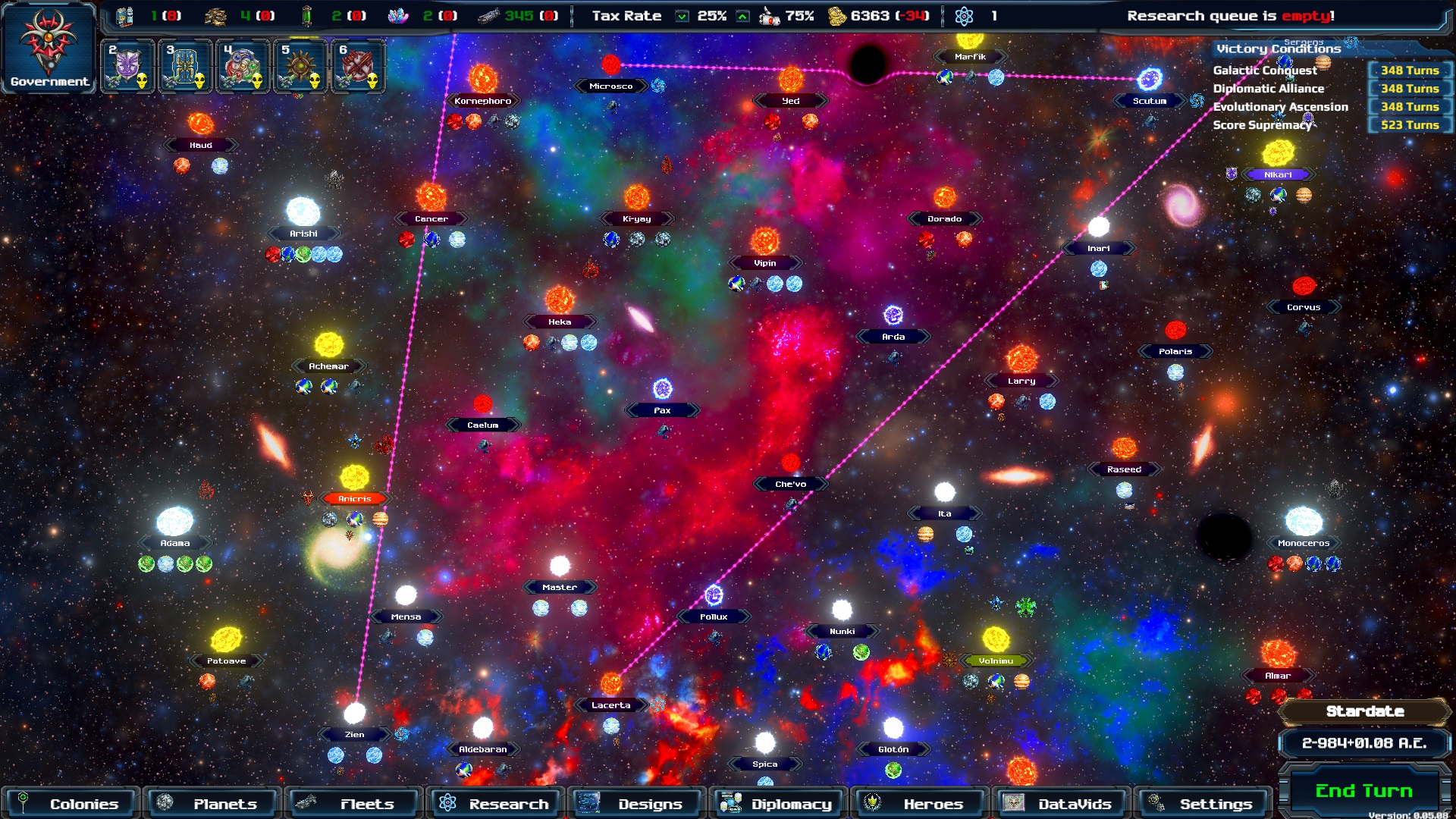
The mechanics of the game are comfortably familiar. You've got star systems to explore, planets to colonize, ships to design, buildings to construct, technology to be researched, and leaders to be recruited. There are a variety of resources to keep track of, and money to be taxed and spent. Most of this works the way you would expect it to, with a twist here and there. Raising taxes brings in more revenue per turn, but decreases morale which in turn reduces the generation of other resources. You need cold hard cash for a lot of things, including the rushing of new construction. However, you also need all of those various resources to get your war machine up and running. As the population on a planet grows, you can allocate the "units" of population into different tracks, so as to boost the production of food, or speed along construction. 

Exploring and colonizing new worlds will bring in more of everything, but high quality worlds are a few and far between. You can research various terraforming projects to make worlds more habitable, but that too comes with a trade-off. One unique mechanic in Astra Exodus is that the tech tree is semi-randomized and split into numerous different fields of study, such as weapons or economics, etc. Within each field, you will have techs available for research, but can only choose one, leaving the other two locked out for the rest of the game. Then you get another three to choose from. While somewhat arbitrary, this limitation is interesting in that it forces you to potentially try new strategies and builds for your empire depending on what options you have available. I like this, as one of the biggest complaints of traditional 4X games is that the tech trees can be very boring and lead to the same choices every match.


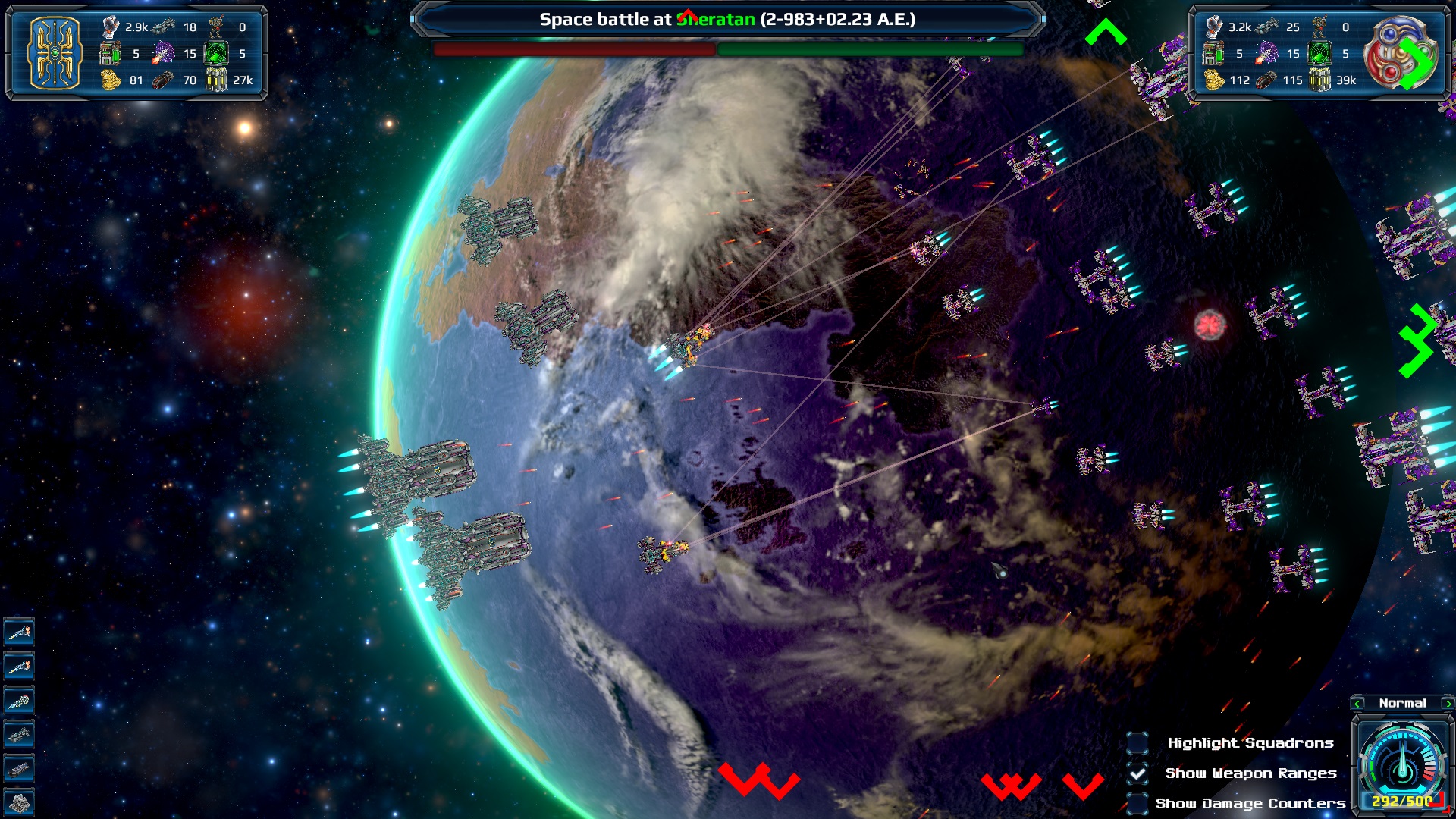
I could go on describing more of the mechanics of the game, but like I said, this is a deliberately "retro" take on the 4X, and so most of it is stuff you have seen before. The diplomacy side of things is pretty standard, with the benefit of AI factions that are actually willing to make fair trades with you. This is one way you can get those technologies you missed out on, by swapping with other factions. The internal economics of your empire is pretty standard as well, you build mines to get more metals, high-tech farms to get more food, and so on. The one area where this game really does shine and even do things a bit better than some more contemporary games is the battle system. 

Astra Exodus does allow you to design your ships, and in this game there is actually more to it than just jamming the best stats possible into each ship. That's because the combat plays out like an RTS, with range, facing, and the speed of your ships actually making a difference. I always love any game where you get to handle space ships turning to bring undamaged armor to face the enemy, or racing in close to use short-range, but high damage weapons mounted on smaller ships. Astra Exodus has that and it works really well in my experience so far.


The game does have a quite a few issues, though none are major they add up to enough to drag the game down. The UI is clunky in places, requiring more clicks than necessary to get in and out of where you want to be. It's single player only, so you can't have a match with friends. The campaign missions can be a bit of a slog at times. The graphics will certainly not be everyone's cup of tea. Frankly, the $30 price tag is hard to swallow when more other, far more substantial games can be had for about the same price. It's enough that I can't really give the game a recommendation unless it is exactly what you are looking for: a new take on the old style of 4X space games. I think as an iPad game this would be great, but on PC there are just too many other options that have a lot more to offer.


That said, this product is the result of the efforts by Atomic Kaiser, a one-man game studio in Uruguay, and I really don't want to discourage him from continuing game development. Astra Exodus does a lot of things right, it's just that a lot of it has been done before and I'm looking for something different. However, you might be seeking a retro experience, and in that case Astra Exodus is certainly worth a look.

Astra Exodus can be found on the Slitherine store and on Steam.

http://www.astraexodus.com/


- Joe Beard


Richard III and the Battle of Bosworth by Mike Ingram  To start with, we must discuss the books title. It is so te...

Richard III and the Battle of Bosworth by Mike Ingram Richard III and the Battle of Bosworth by Mike Ingram

For your Wargamer, Toy soldier collector, MiniFig collector, military history nut. Reviews, interviews, Model Making, AARs and books!


Richard III and the Battle of Bosworth

by

Mike Ingram


 To start with, we must discuss the books title. It is so terribly named for a book with this much information. You would expect a book of about 100 pages just on the Battle of Bosworth. In actuality, the book is almost 300 pages long and is filled with the history of not only England during the entire War of the Roses (and after), but also France, Scotland, and Brittany. Not only that, the book also does a very good job of discussing the weapons and warfare of the period mentioned. The easiest way to show this is to give a list of the book's chapters. They are:

The War of the Roses
Weapons and Warfare in the Reign of Richard III
Richard: Duke of Gloucester
Henry Tudor
France, Brittany and Henry Tudor
Richard: The King
Rebellions
Preparations
Invasion
The Battle of Bosworth Field 22 August 1485
King Henry VII
Epilogue

Appendices
I finding the Battlefield
II Finding Richard
III Order of Battle


 We must now turn to some 'facts' and not some historical conjecture. First, Richard did not kill the 'Princes in the Tower'. There were more than a few writers at the time who detested Richard. None of these accuse Richard of the Princes' death. Second, Richard did not poison his wife Anne. This point is also brought home by the absence of accusations in the above authors. Most of the lurid stories come from after Henry Tudor is made king. Third, Richard was not 'crookbacked'. He certainly suffered from scoliosis, but no man with the body deformities he is claimed to have (again after Henry Tudor's crowning), could wield the weapons he is known to have used in various battles. I will add that the Princes did not escape the Tower, and were then raised by wolves or Irishmen (Which would be worse? This point is my own). All the other 'facts' are gone through in the book and discarded because of the light of history having been thrown on the subject.

 This book, having brought us the historical Richard, would be enough for the author to sit back and enjoy his laurels. However, he is not done by a country mile. His writing about the War of the Roses is good enough for a small book on its own. The added parts on the weapons and warfare of the age are equally excellent. 

 Now we come to the heart of the matter, the actual Battle of Bosworth. The author gives us almost an hour by hour account of the invasion of Henry Tudor, and all of the moves each side made before the battle. The strangest part of the book to someone who has read a good amount about the battle is the author's take on the Stanleys. In most every account, it is said that William and Thomas Stanley stayed aloof from Henry Tudor's forces, and that they only decided on treachery at the last act of the play. The writer shows us many accounts from the time that Richard's and Stanleys' men were already fighting each other even before the battle. This means that there was no way for Richard to be surprised at their attacking him and not Henry Tudor. This is one of many excellent historical detective points that the author makes in this work. The savage attack of Richard into the men around Henry is also shown the reader. So too, unfortunately, is the postmortem of Richard and the death of the last Plantagenet.

 The book itself is filled with illustrations from the time period and also now-a-days. From pictures of the various combatants to actual cannons used at the time, the book is rife with them. There are also several pages full of colored plates, and the actual pictures taken of Richard III's skeleton. The maps of the actual battle are also very well done. Thank you Helion & Company and Casemate Publishers for letting me review this excellent book. This book is a thorough history of the times before Richard's rule and slightly afterward.

Robert

Author: Mike Ingram
Publisher: Helion & Company
Distributor: Casemate Publishers


Wars Across the World: Spain 1936 by Strategiae Avalon Digital  I had reviewed the base game and its ...

Wars Across the World: Spain 1936 by Strategiae and Avalon Digital Wars Across the World: Spain 1936 by Strategiae and Avalon Digital

For your Wargamer, Toy soldier collector, MiniFig collector, military history nut. Reviews, interviews, Model Making, AARs and books!


Wars Across the World: Spain 1936

by

Strategiae

Avalon Digital


 I had reviewed the base game and its scenarios (link will be at the bottom), and I was very impressed with some things about the game. This is the one game where you can play battles from ancient times to nowadays. Scenario designing across such a huge swath of time is a pretty huge undertaking. In games like these, we are used to some scenarios being great whereas some are not so. It is so much in the hands of the designer of the scenario. The one thing that I was not really impressed with in the game was the AI on several of the scenarios I played. I had been assured after the review that work was continually being made on the AI. So I was asked if I wanted to review the scenario Spain 1936. Instead of just a battle, this will be the entire Spanish Civil War. So, if the AI was going to stumble, this was a perfect scenario to test it on. Let us see how much, if any, it has improved and how good WAW does on a large war scenario.


 A quick synopsis of the war is that the Nationalists (Fascist) are fighting the Republicans (Communist, Republicans, and Anarchists etc.). Neither side has a real government at the start and they are both starting from scratch. Both sides do have parts of the Spanish Army, but the Nationalists have a leg up on the Republicans because of Franco's Spanish Moroccan veterans. These will be flown in from Spanish Morocco by JU 52s (Auntie Jus or Iron Annies). Speaking of which, the Spanish Civil War was used as the test bed of almost everything military in World War II. The Nationalists had the support of both Mussolini and Hitler, hence the JU 52s. The Republicans were supplied mostly by the Soviet Union, although they did get recruits from around the globe, along with some very well known authors. Enough of the history, let us go back to the game.


 As I had mentioned, there is a bit of anarchy on both sides in the beginning. The Country is split up into chunks of territory belonging to both sides. Playing as either side, you have to decide which areas you definitely want to keep control of and which you can let go. You are not going to be able to keep it all. Playing as the Republicans, you have to keep the coast so that you can get your supplies from the Soviets. I forgot to mention that the Spanish navy is also split between the two sides. So there is a naval component to the game.


 The game is turn based with area control and movement. It is not a card driven game, but it is augmented by cards that each player has. Some of them can be real game changers, and others just increase odds in battle or movement or some of your forces. The game is not just an Axis and Allies clone and is much deeper than it would seem at first. The rulebook is 116 pages long, so that should give you some idea. The scenarios do not seem 'cookie cutter' in that a tank is just an elephant in the 20th century battles etc. Play is fast and the somewhat small amount of forces (compared to a monster game) enables you to play maybe two scenarios in a gaming session. The price of most of the scenarios is $2.99, with a few larger ones being $4.99. Spain 1936 is the most expensive at $7.99. So you can see a little will go a long way. I was remiss in my first review and did not mention a free scenario about Innsmouth in 1928. Being an alumnus of Miskatonic University, I don't know how I missed it.


 Call me impressed, the game's AI seems to have come a long way, or perhaps just a ton of work was put into this scenario. The AI seems to be much more aware of itself and also of your moves. When I played before, in some scenarios it seemed that the AI was totally oblivious to your moves and its imminent danger. I will be honest and say I played mostly as the Republicans and not very much as the Nationalists. The Republicans are really the underdogs here and I almost always play the underdogs in games. So the scenario is by far the best I have played. I will need to revisit the ones I played earlier and see how much improved they are. There has also been made available a free download of a scenario editor that comes with some preset battles in it. You can now change what you want, and even create your own if you are so inclined. Thank you Strategiae and Avalon Digital for letting me review this very good add on to your game.

My review of Wars Across the World:
https://www.awargamersneedfulthings.co.uk/2019/11/wars-across-world-by-sas-strategiae.html

Robert

BATTLES OF THE BLACK CAVALRY HILL262 - CHAMBOIS from STRATEGEMATA My experience up to now of this small Polish war games company ...

BATTLES OF THE BLACK CAVALRY BATTLES OF THE BLACK CAVALRY

For your Wargamer, Toy soldier collector, MiniFig collector, military history nut. Reviews, interviews, Model Making, AARs and books!

BATTLES OF THE BLACK CAVALRY
HILL262 - CHAMBOIS
from
My experience up to now of this small Polish war games company has been of their Art of War in C19th through reviewing Battles of the Bloody Steppes covering three battles of the Crimean War.  So, I was very pleased to be given this opportunity to explore their series Great Battles of Small Units.

This is the fourth game in the series and I must confess that I hadn't paid too much attention previously because of the relatively obscure nature of the battles covered.  Battles of the Black Cavalry had already involved the earliest days of September 1939, but this second game to feature the Black Cavalry transports us forward to August 1944 and provides four scenarios set in the actions of the Allies to close the Falaise Gap.

As with other Strategemata games the production values don't match the quality of the major publishing companies.  The single, glossy paper map is quite thin, but printed on both sides.  Its size is approximately standard folio.  The counters [of which there are a good few] are very thin and small.  They sit well in the good size of hex, but the very small numbers printed on them, especially Gun/Armour factors and unit designations can be a trial to read.

Their flimsiness also makes picking them up or adding and removing markers delicate and at times frustrating work.  Play aids too, such as the scenario cards and terrain chart, are on barely more than glossy paper.  


Player aid for one of the two introductory scenarios

Finally, the rule book too is fairly light weight with a mere 8 pages of which six cover the rules and the final two contain examples of key rules.  So initial impressions of the physical side of the contents left me with some reservations.

However, reading the rules and playing the scenarios creates a very much more positive impression.   First of all the rules introduce a system containing a number of very interesting concepts.  The first and perhaps most important is the use of a deck of ordinary playing cards [which perfectly acceptably you will have to provide for yourself] to regulate and introduce a mixture of control and randomness into the game.  This is an element not unfamiliar from some miniatures rules and systems.  [An excellent instance being To The Strongest - a superb set for conducting Ancient warfare!] However, I haven't previously encountered this in board wargaming.  Here all court cards count as 1 pt, while all other cards have their face value.

From the outset, these cards govern everything, including who will have the Initiative and play the turn.  This latter rule stands out for me as a leading innovation and one I have certainly never met with before.  There are four Initiative markers, one for each of the four suits in a pack of cards: Hearts, Clubs, Diamonds, Spades.  On one side of the marker is a flag to denote the German player, on the other a flag for the Allied player.


Illustration of the Initiative markers and accompanying rules

A pre-game card draw will determine which suits will determine each side's potential starting Initiative.  From then on, each Turn begins with a card being drawn, the suit determines the Initiative player and the Initiative marker for that suit is turned over to the opponent's side.  Thus a rhythm is established that overall evens out, but can throw up surprises and causes each player to focus very carefully on what he/she needs to do when they have got the Initiative.

What is even more novel is that only the player with the Initiative gets to directly activate their units with a choice of actions from Movement/Improving a Position/Fire and Rally.  However, and this is the third original idea, the non-Initiative player's units have a limited reaction ability.  Each unit can either move away one hex when an enemy unit comes adjacent or, at the point when an enemy comes into range and line of sight, can"roll" [i.e. draw a card] to see how many reaction pts the unit gets.  This will allow the unit from 1 to 3 Defensive Fire opportunities. 

This sets up a highly interactive system that benefits defenders well dug-in on good defensive terrain, especially when the Initiative player has to cross open ground.  It also creates a fairly fast flowing pace to each turn, with the opportunity for reaction, but without an overcomplex set of rules and conditions. .

What I like even more about the use of cards instead of dice is that each player starts a Scenario with a a limited hand of cards, with rare Random Event opportunities to refill or exchange some of those cards. In a variety of cases, a player will have the opportunity to play a card rather than randomly draw one.  

Nowhere can this be more crucial than when you have the Initiative, as your first decision is always how many formations you are going to activate.  To activate a single formation is free  and guaranteed.  To activate more than one formation, then each formation costs 2pts and each support weapon costs 1 pt unless it is stacked with a unit from its formation, an Artillery strike costs 2 pts and an Air strike similarly costs 2 pts.  You must first announce what you are attempting to activate.  Obviously then you can use one of your precious cards in your hand to guarantee success, but if you choose to risk a random card draw and don't pull a card that will pay all your costs, then you forfeit all activation!  

Lots of tense moments here, especially if you have a lot of nice court cards in your hand which count as 1 pt - and remember you can only ever play one card.  So, perhaps you'll be saving those high point cards for activation purposes in crucial turns, but they're equally useful in Fire and Close Combat.  

Fire is very straightforward with each unit firing separately.  It involves simply the play or draw of a single card plus double the unit's firepower compared with the defending unit's morale added to its terrain cover.  If the Attacker scores higher, the Defending unit is disorganised and, if twice the Defender's score, then the unit takes a step loss as well.  Gun/Armour factors add a few more twists too,  though their main problem lies in the minute size of the print on the counters!

Close Combat involves a more complex combination of cards, drawn randomly/played from hand, both face down and face up.  This takes a little thoughtful reading, but help is at hand as a substantial amount of the two pages of examples is devoted to a very clear sequence illustrating these particular rules.

By now, you're probably thinking that the many cards in a deck that are only worth one point serve mainly to clutter your hand or are lurking to be drawn randomly just when you don't want them.  Well. at times it does seem just like that, but be assured they can and do play their part.  When you need to remove a disorganised marker by rallying, a score lower than your morale is required - what better time then to play a 1 pt card.

But wait, you'd just had one of those rare random event chances to discard some cards and all those 1 pt cards had been traded in.  Such is the agony and ecstasy of decisions in this game.


Random Events linked to certain cards

Considering that all this, plus chrome such as random events,  mines and destroying objects as well as Air & Artillery strikes is covered in just six pages is a major achievement, especially counting the degree of innovation I've outlined.  You'll need to read the rules carefully as they are close packed and occasionally, in the early stages of learning and playing the game, I was left thinking that's what I've got to do, but where exactly did I read it.

However, the scenarios provide a very good range that help greatly in getting a feel for the rules.  They start with two very short scenarios that introduce basic rules and can be played in about an hour.  Despite their brevity they not only help to embed the rules, but are genuinely fun to play and mirror the situations that you'll meet in the two major scenarios:  namely, taking or holding an objective and getting units across and off map to win. 

Here you see one of the large scenarios and one of my favourites.  Note "large" is a relative term as it can still be played in about 3 hrs.  What you get is a small Polish force defending a hill, but needing to move some of that force to block the advance path of the German units that will be trying to cross the map from south west to north east and exit the map.


Here's the map itself with the hill to the north and the crucial narrow spur of the hill running down the length of the map.  The next image shows the very short, but rewarding small scenario that plays out on part of that map, as a mixed American/Polish force seeks to thwart the exit of a ragtag group of German stragglers.


The well grouped Allies from only two formations are easy to activate, while the strung out German forces from several formations and with unstacked support weapons demand more careful handling.

So, all in all, this is an innovative and accessible system backed by scenarios that play well, but the presentation would be greatly enhanced above all by a physical upgrade to the counters.  That said, Last Vikings, the next Strategemata game that I shall be reviewing at a later date, does exactly that with some gorgeous counters.

As always, a big thank you to Strategemata for kindly providing the review copy.


hpssims.com