second chance games

Search This Website of delight

This bumper box holds a smorgasbord of interesting game design, high production values, engaging artwork, a cacophony of components and more...

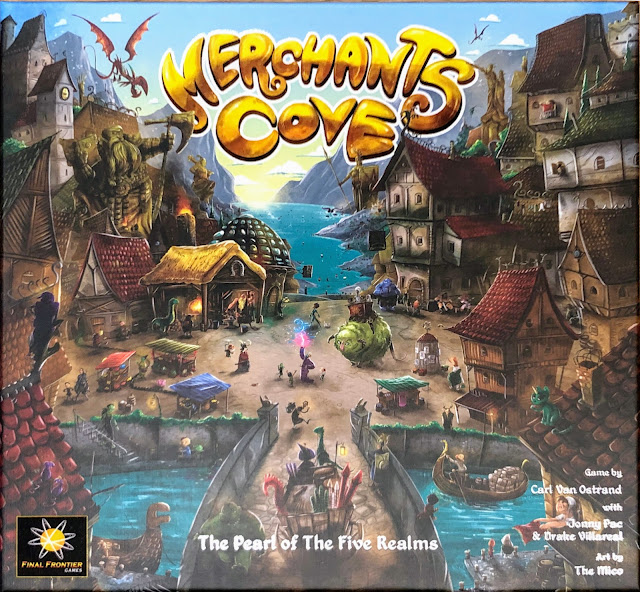
Merchants Cove by Final Frontier Games Merchants Cove by Final Frontier Games

For your Wargamer, Toy soldier collector, MiniFig collector, military history nut. Reviews, interviews, Model Making, AARs and books!

This bumper box holds a smorgasbord of interesting game design, high production values, engaging artwork, a cacophony of components and more plastic and carboard than any game should rightfully have.


Merchants Cove sees 1-4 players become a Merchant (*gasp*) flogging their wares to visiting adventurers that have bottomless pockets.  As the shops are in a cove (*shock*), the adventurers always arrive by boat, some stay and some leave to return by boat again, for more gear.
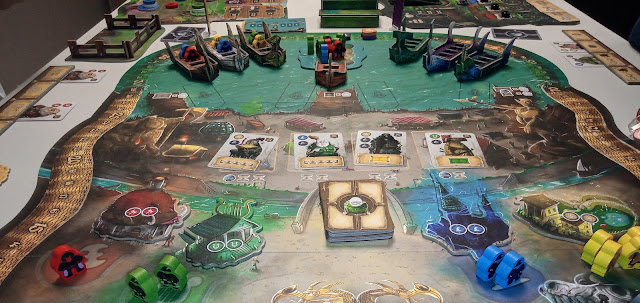

The way in which you craft items in each shop is utterly different and arguably each player is actually playing two games.  The first is played out on the central board and the second mini-game is done on your own shops’ action board.  In terms of mechanics, it’s got a bit of everything, but for me this is simply an engine builder with lots of added chrome.

Gameplay

In the game you play as either a blacksmith, an alchemist, a sea captain, or chronomancer (I must admit I have no idea what one of them is – something to do with using time).  The blacksmith and alchemist sell typical goods and potions; the captain sells fish, shells and treasure, the chronomancer sells artefacts from time travelling … as you can probably tell the theme is stretched a bit thin throughout the game but it just about manages to keep it all together.
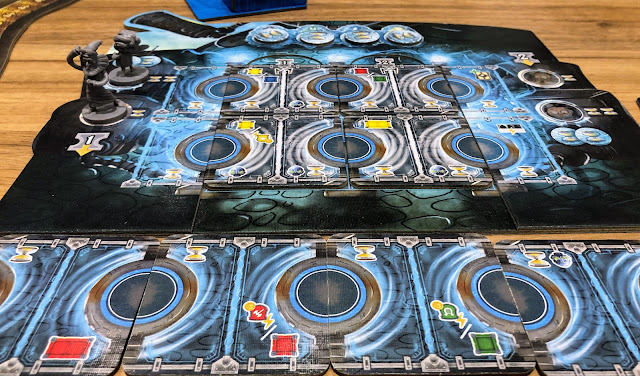
This is the board the Chronomancer has to play with

The game will end after three market phases, the player with the most money wins.  Each shop crafts coloured (red, blue yellow and green) small and large items that can only be sold to the same-coloured adventurers on the relevant (small or large goods) pier.  The game end feels like it comes relatively quickly and I’ve not been at a table where this has outstayed its welcome yet.  


The meta-game, played out on the central board is where you’ll get the only player interaction.  This comes primarily from loading boats with adventurers that either help you or hinder your opponents.  Hopefully a bit of both!  However, what interaction there is does feel mean (that’s a good thing), sending a boat full of blue adventurers to the small goods pier when your opponent only has large blue goods is a good feeling. 
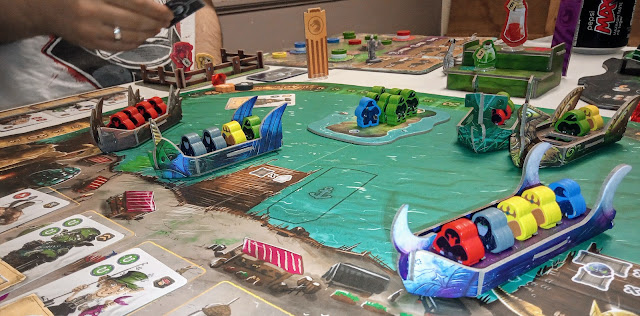
Large red goods are in high demand (far boat, all red adventurers at the large pier)

 However, in my experience, it is probably better to optimise for your own play, as there is nearly always a way to mitigate the damage you could cause to an opponent.  For example, your opponent doesn’t have to sell any goods during the market phase and can keep them all for a more favourable market phase. 

The smaller games are played out on each shops’ activity board and are completely different from each other.  Despite their uniqueness, each shop does feel balanced and can score as easily (or not) as each other.  These mini games are the unique selling point for this game and each time I’ve played with a new shop I’ve appreciated small nuances that weren’t immediately apparent at first glance.  I’m sure that some clever game designers could make a big-box game just out of the mechanisms on each shops’ board.
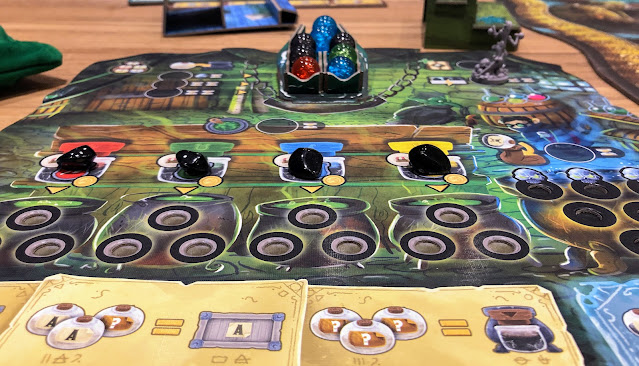
The Alchemist's board.  The marble filled decanter is the mini-game here.

Due to each shop’s uniqueness they have their own rule pamphlet.  This can make for quite a lengthy teach to what is quite a simple game.  If you’re comfortable with your shop the main game is on a par with Catan for complexity and approachability.  This asymmetry has drawn comparisons with Root which although more complex overall, has less asymmetry than Merchants Cove. 


Every single action you take on your turn will have a time cost and potentially a penalty corruption card as well.  This moves your time tracker one or two spaces around a clockface which acts as the game’s timer.  Passing certain points on the clock with your tracker will cause the boats to fill up and eventually trigger the market phase.  Player turn order is variable and dictated by whichever time tracker is furthest back on the clock.  This may allow you to plan a double turn which if timed right could allow you to choose which boats dock at two of the three piers in the cove.
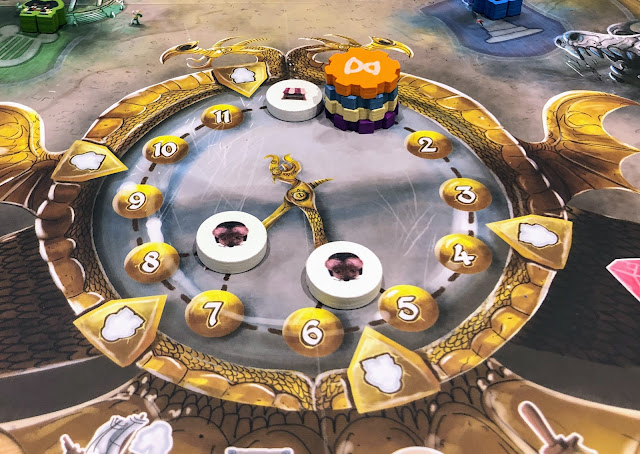
There's mice, because there are...(actually useful but just more stuff)

Shuffling round the clock face or racing to the next market phase is deceptively simple. Invariably I am always looking to get another turn in after the market phase has been triggered.  Which shows that this game has been well balanced and I’m always immersed in the act of optimising my goods production and finding selling opportunities during the market phase.


During the market phase the base value of each of your sold goods (small and large is the same for every player) is multiplied by the number of similarly-coloured adventurers om the pier for your score.  For example, if you’re selling 2 large goods to 3 adventurers you’ll be looking at 48 points. (value 8 gold x 2 goods x 3 adventurers).  There will be some small bonuses for the number of adventurers in the guilds and penalties for corruption cards which definitely should not be ignored.  
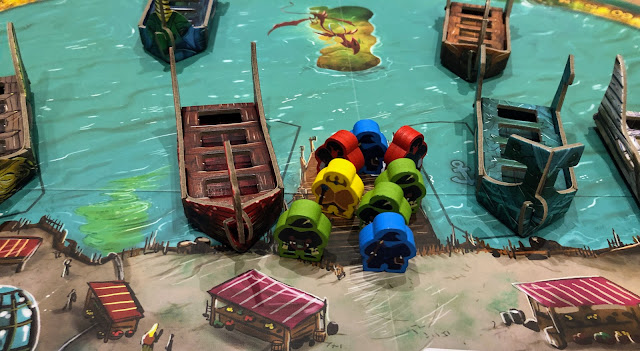
Clamouring for small goods

Due to the large scores that are possible and each players hidden corruption cards it is not possible to determine who is winning or losing until the final scoring has been completed.  During my first real play with actual people (!!!) I thought I was down and out going into the last round and there was no way to catch up to my opponent who seemed to have a shelfful of goods.   However, come the final scoring I snuck ahead and the supposed winner actually came last (in a 3 player game).


The reason why I call this an engine builder is due to the set of upgrades and powerups each shop can do.  Each shop has a staff of four actions which can be done when villagers are hired onto your staff.  If you’ve only got one hire then your staff action is fairly weak.  If you’ve filled all four positions you’ll be wanting to do it every turn…although you can never take the same action twice in a row.  Similarly, there’s an element of set collection you’ll be doing which could also provide a massive point swing in final scoring.
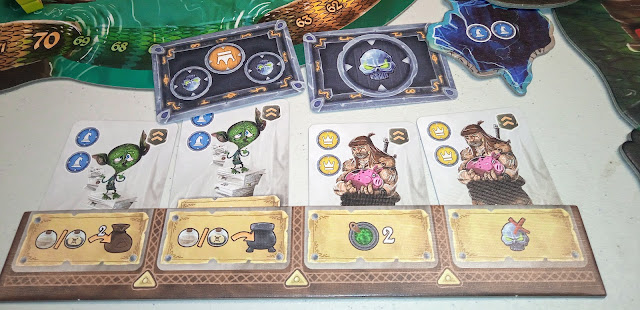
Fully employed staff

If you’ve got this far you can tell that this game has a lot of things going on and decision points.  I certainly don’t feel like I’ve explored everything the games got to offer and there is a good deal of replayability.  I am keen to keep playing it although it is not without its flaws.

Criticisms

I think it’s fair to say this game is less than the sum of its parts. However, it has got an impressive array of parts that certainly doesn’t mean this is a bad game. It’s not even a ‘meh game it’s an interesting game.  It’s as if the designer(s) had so many ideas and tried to put them all into a game.  The fact that I want to keep playing it means that it’s a success (it works), I’m just not sure if its excellent, good or just interesting… I don’t feel like there’s anything like it in my collection.
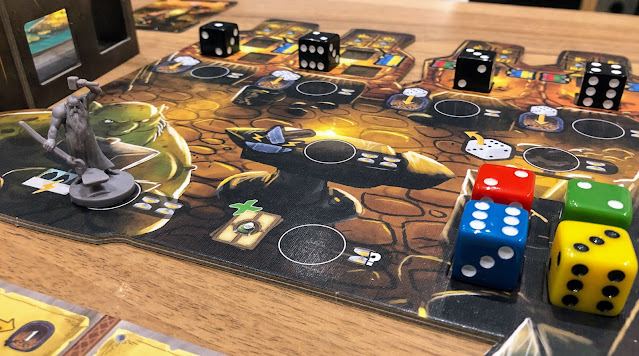
Blacksmith forging dice.

The uniqueness of each shop and their mini-game is impressive but could be bewildering for new players.  I shudder at the thought of teaching this to 3 new players because the teach can easily go on for 20 minutes if you have to explain each shop.  Thankfully the individual shop’s rules pamphlets are fairly concise and could be read by each player during setup and after the main rules have been digested…questions will still come.  I’ve not found an optimised way to teach it yet.


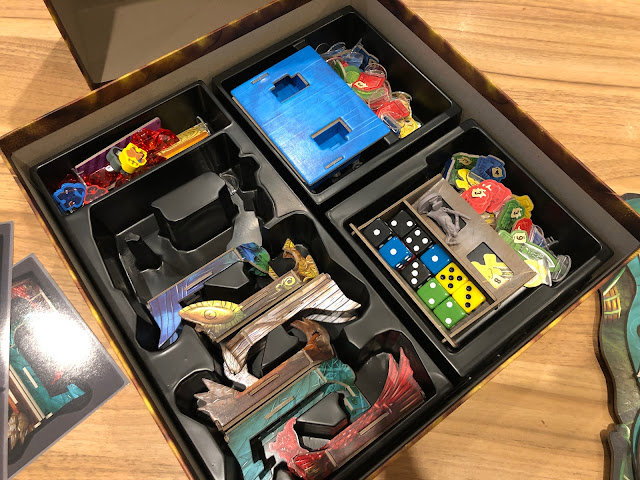
Unfortunately, due to the completely asymmetric shops each one has got their own sizable board to play on as well as the large central board.  Not to mention the unique bits each shop has and the components, this game takes a bit of time to set up.  This is helped by some of the best inserts I’ve ever seen in a game, but it will still take some time, unless everybody is familiar and can help out.  Similarly, this game is a table-hog, you will definitely need a large playing area for this monster.
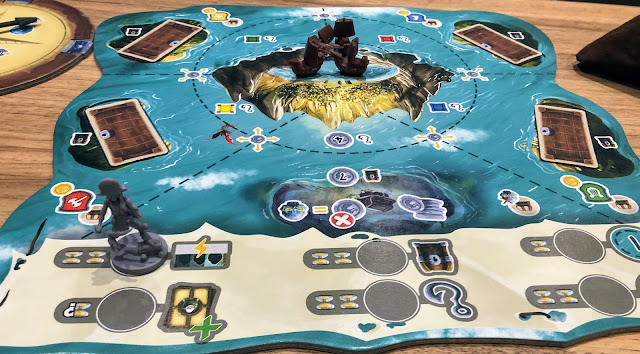
The Captain's board.

Components

Needless to say, this was successfully funded on Kickstarter.  The components are singularly of excellent quality, the designer is making cardboard do things which it was never designed to do.  It really does look impressive on the table thanks to the light-hearted fantasy art that is dripping off every component.  You don’t get any square / boring edges here everything is shaped, moulded, drawn upon to make everything interesting to look at.
The final mini-game...

There are probably too many components provided for each shop as I’ve never come close to using even half of any shop’s goods.  I still find it difficult to pack it all away despite the excellent insert and the essential packing instructions.  Lose those and you’ll be storing it all across two boxes and will have a lot of broken carboard.  It’s almost a game in itself to pack it all way!

Conclusion

If you’ve got this far you can tell that this game has a lot of things going on and decision points all wrapped up in a really unique game of games.  Sometimes the theme feels quite loose but it’s a testament to the designer, and this game, that so many different moving (metaphorical) pieces comes together as neatly as they do.  All the different merchants feel balanced and everyone is in with a chance of winning right until the end.  I can easily recommend it to any gamer to at least try a few times to see what hyper-modern games can deliver.  


Unlike this review, I have never felt that this game has outstayed its welcome it always seems to finish just in time… 


I’d like to thank Asmodee UK for sending this review copy. You can use this link https://www.asmodee.co.uk/contentpage/find-your-game-store to find your Friendly Local Game Store.


Designers: Carl Van Ostrand with Jonny Pac & Drake Villareal
Playtime: 90 minutes
Players: 1 - 4


  The Deadly Woods by Revolution Games Designed by Ted S. Raicer    So, we have another Battle of the Bulge game to enter the fray. Three ba...

The Deadly Woods by Revolution Games The Deadly Woods by Revolution Games

For your Wargamer, Toy soldier collector, MiniFig collector, military history nut. Reviews, interviews, Model Making, AARs and books!


 The Deadly Woods


by


Revolution Games


Designed by


Ted S. Raicer


 So, we have another Battle of the Bulge game to enter the fray. Three battles pretty much flood the board wargaming industry: Waterloo, Bulge, and Gettysburg. Some would argue that enough is enough. Those same people might also like to eat turkey, ham, or whatever. You do not hear them being upset that someone has cooked their favorite meal again. To me, The Battle of the Bulge in wargaming is an acquired taste. It is one of those battles that one side has the scales all tipped in their favor. The German generals were pretty much in agreement that the plan was slipshod at best. Even Sepp Dietrich, rabid Nazi that he was, thought the plan was beyond the resources assigned to it. That, and the atrocious weather needed to keep the Allied planes grounded, also affected the ground troops of both sides. As it was, the German Schwerpunkt (main point of attack), the SS Panzer Sixth Army in the north, did not punch through the American lines. The American troops bled and died there on the Elsenborn Ridge to stop them. The deepest penetration during the battle was actually further south by von Manteuffel's Fifth Panzer Army.


 This is what comes with the game:


Components

22x34" game map

11x22" setup map

1 1/2 x 5/8" countersheets

Rulebook

Player aids

Game box or ziploc


This is a blurb from Revolution Games about The Deadly Woods:

"In December 1944 Hitler launched a massive offensive against the weakly held Ardennes forest section of the Allied front in Belgium. Achieving complete surprise, the Germans nevertheless faced tough resistance from the battle's opening days, and the offensive was virtually over 10 days after it began. Their followed a bloody Allied counterattack which gradually erased the bulge the Germans had created in the Allied line.

But you probably know all that. Yet another Battle of the Bulge game? Why yes. But one with a different approach. Specifically, award-winning designer Ted S. Raicer has taken a modified version of the chit pull system pioneered in GMT's The Dark Valley: The East Front 1941-45 and brought it west for an exciting new take on this classic wargame subject.

So another Bulge game, but one with the historical action and decisions of games with a much bigger footprint and playing time. And with a unique take on the chaos and friction of the battle that makes it a great choice for solo play. Even if you are bulged out, you'll want The Deadly Woods in your collection!"


 Exactly why do we want another Battle of the Bulge game? The key point to the information above is the name Ted S. Raicer. That name should get you to perk up your ears like a dog. ​

  
 As you can see above, the map is smaller than most Bulge maps at three miles per hex. However, this also means that a lot of the necessary items for play, Turn Record Track etc., have a place on the map. This gives the game a smaller footprint. The size of the map fits right in with the design for a smaller, easier to play, Bulge game. Not simple, just easier setup and shorter play time. The map itself is well done and is fully functional instead of heading in the artsy direction. It is after all a map. The game also comes with a small 'Setup Map' that makes it easier to see where the starting units are placed. The oversized hexes of the map allow the counters to be larger in turn. All of the unit counters are 1 1/2" in size. Their size allows all of the historical and pertinent game information to be read easily. The units that start on the board have their 'Setup Number' on them for ease in setting up the game. The other counters, out of supply etc., are still large at 5/8". We old grumblers always appreciate that in a game. The Rulebook is in black and white and is twenty-three pages long. The rules do not come with a historical background simply because this is a game about the Bulge. However, the Designer Notes are an interesting read. There are three Players Aids that are in full color and are hard backed and not just sheets. They are akin to the rest of the components in having large print. One thing I have to mention is the artwork on the box. For us grognards it might seem a bit strange. There is no Peiper or at least a Tiger or a Sherman adorning the cover. In fact, it is bereft of any soldiers or weapon of war. It is simply a picture of trees, mostly conifers, in a winter setting along with snow. After looking at it for a bit though, I get a bit of the foreboding that was put into it. What is in those trees? So, the cover as a piece of art is to me a really well done, suspenseful looking and feeling picture.


 The game is slated as playing well both for single player and two player games. I can attest that it plays well as a solitaire game. Most of the units have stepped counters, so there are not large amounts of counters to deal with each turn. A minimalist Bulge game is what we are looking at. This seems completely contrary to the norm in Bulge games. Usually, they try to go down to the level of individual tanks etc. I am jesting, but you know what I mean. Most come with four to five maps and hundreds if not thousands of counters. This game, although much smaller, has been able to add in all of the glitz of the Bulge as in:

Supply
Bridges: intact and blown
Divisional Integrity
Artillery
Airborne Units
Engineers
SS Withdrawl
Operation Greif

 The design is based on Mr. Raicer's 'Dark' series of games. Due to legality etc., the campaigns he is designing for Revolution Games will be called 'Deadly'. Beyond the name change, there is not supposed to be much difference in the play. So, anyone playing the Dark series should have no trouble understanding the Deadly series and getting down to playing them rather easily. The game is easy to learn and the rules are setup well. As the Germans, just as historically, you have to get the 6th SS Panzer Army moving. The 'easiest' way across the Meuse is at Liege. Of course, the Allies know this too, unless your opponent's map reading skills are subpar. As the Allies you have to hope that your troops can pull off another miracle at the Elsenborn Ridge. The game comes with two scenarios. The first is the 'German Attack' and it lasts six turns. The other is the "Campaign' which lasts twelve turns. There are nineteen Victory Point hexes with nine of them being across the Meuse. Do not, repeat, do not as the Germans expect to get there. There is a 'Sudden Death' victory for the Germans if they are able, at the end of any turn, to have five Victory Point hexes with a line of supply or have nine or more Motorized steps across the Meuse in the British Area in the north of the map. If you are playing the Attack scenario, the Germans win if they have four Victory Point hexes with a line of supply. If you are playing the Campaign scenario, the German player needs either two, if he withdraws the SS, or three Victory Point hexes with a line of supply if he does not withdraw the SS.

 The bottom line is that this is a refreshing take on the Battle of the Bulge. A relatively simple design, certainly not beer and pretzel, and it is a quick playing 'fun' game. Its small footprint allows for the player(s) to try many different strategies without having to worry about the space the game takes up. I can easily recommend this game to both grognards and people starting out in the hobby. Thank you, Revolution Games, for letting me review this game. Please check out their other fine games when you go to their website. 


Robert


Revolution Games:

Revolution Games | Main Page

The Deadly Woods rules in PDF:

1 (revolutiongames.us)

This is my review of 'Longstreet Attacks' another fine game from Revolution Games:

Longstreet Attacks by Revolution Games - A Wargamers Needful Things


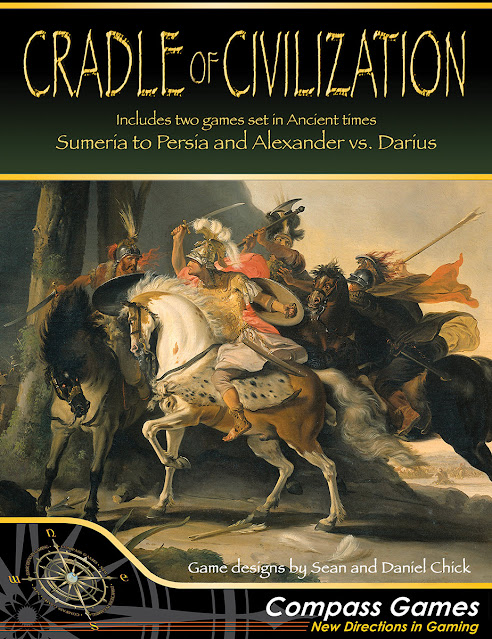
 Cradle of Civilization Includes Two Games: Sumeria to Persia & Alexander vs. Darius by Compass Games     The ancient Near and Middle Ea...

Cradle Of Civilization by Compass Games Cradle Of Civilization by Compass Games

For your Wargamer, Toy soldier collector, MiniFig collector, military history nut. Reviews, interviews, Model Making, AARs and books!


 Cradle of Civilization


Includes Two Games:


Sumeria to Persia

&

Alexander vs. Darius

by

Compass Games


 The ancient Near and Middle East had a deep and centuries long history. Three of the West's largest religions had their birth there. The first law codes were written down and implemented there. The area had two of the four places around the world where civilization started to flourish first. It is pretty amazing to think that Cleopatra is closer to us than the people who built the pyramids. 


 So, Compass Games has bitten off a lot with two games in one box. We are used to having two games using the exact same rules in one box, but this is different. They have a civilization building game that goes from Sumeria to the Persian Empire. Then there is a totally different game about Alexander's successful attempt to conquer the Persian Empire. The first is listed as easy to medium on difficulty, and the second is listed as medium difficulty.


 I will tackle the Alexander game first. You have to read the designer's notes to understand the game. Their belief that Alexander's winning is not the cut and dried outcome that most have been taught. They think that Darius III had a good shot at beating Alexander except for getting some bad breaks. The worst of these was the death of his general Memnon very early in the contest. Memnon did not, unlike the Persian Satraps (governors), want to battle it out with Alexander. He wanted to use a Fabian type strategy against him. Memnon knew that in a straight up battle between the two forces the Macedonians would win. What he wanted to do was attack Greece with the huge Persian Navy, then always shadow Alexander and try to cut him off from home and getting supplies. In this game you get to see if it would have worked.


 The other game, Sumeria to Persia, is an altogether different  beast. Compass Games always knows where my armor is thinnest. I am a wargamer at heart, and they will have to hit a home run for me to get interested in this kind of game. I have played more than a few of this genre on a board or on the computer, but none so far has been able to keep my interest. So, let us see how they do. The Map board is the same for both games, and the counters only differ in what is pictured on them. Therefore, my assessment of the components will be done together. 


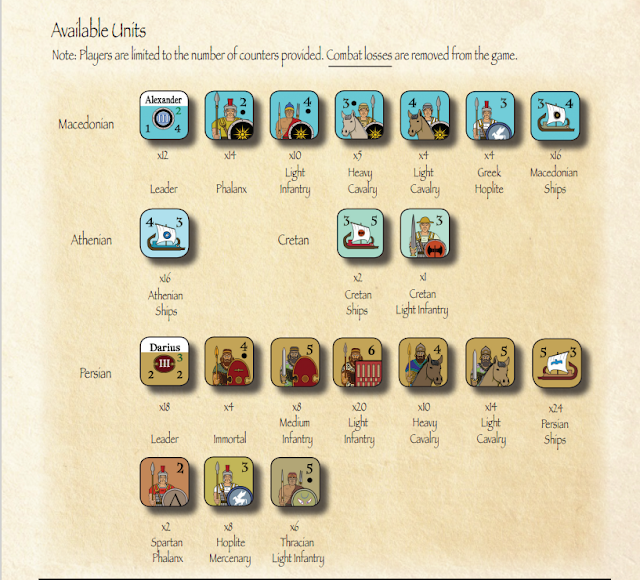
 This is the official Compass Games take on the two games:


Components:

One mounted map (22 X 34 inches)

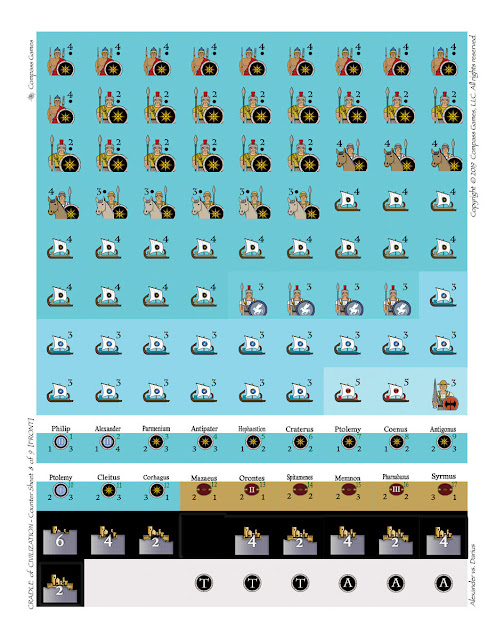
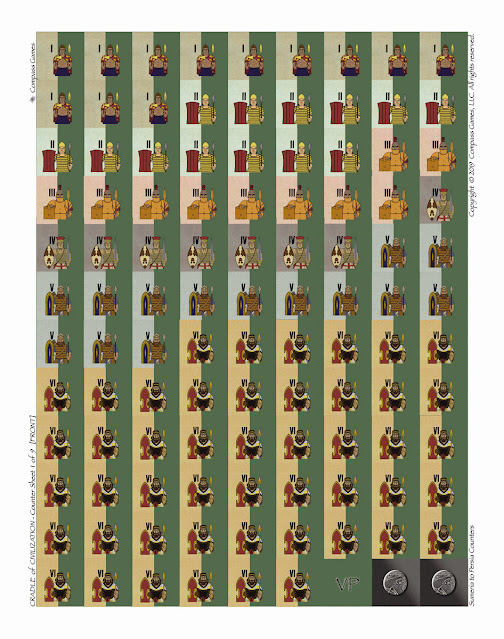
Nine full sheets of large 0.65” counters

Two rules booklet

Six player reference cards

Forty-Eight Nation/City/Epoch tiles

Twelve 6-sided dice

One box and lid set

Complexity: 2 out of 10 (Sumeria to Persia), 4 out of 10 (Alexander vs. Darius)

Solitaire Suitability: 1 out of 10 (Sumeria to Persia), 7 out of 10 (Alexander vs. Darius)

Players: one to six

Playing Time: 3 hours


Game Credits:

Designers: Sean and Daniel Chick

Artists: Bill Morgal and Shane Hebert


 The box is both heavy and large. It is the size and girth of a game that delights us gamers to open. Of course, you should never judge a book by its cover. However, we all do it. We love to spread out all of the box's contents and glory over it like a dragon over its hoard. 

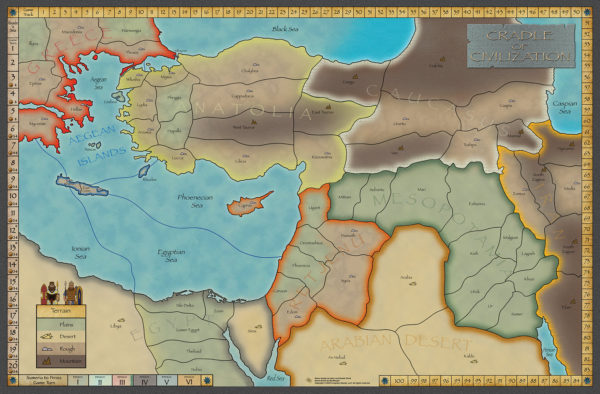
 As you can see above, the mounted map goes from Macedonia to the eastern parts of modern Iran. It folds out completely flat the first time you spread it out. The map is also very sturdy, so it should last through many games. Its colors are easy on the eyes, and still make it easy to see the different areas on it. It is subdivided for area movement instead of hexes. The counters have beautiful pictures on them. They are also large, and they come with the corners already clipped. As far as thickness, these are some of the thickest counters I have ever held. These are very easy to read and see even with old eyes. Now we come to the cards, or should I say clay tablets. The cards are the same thickness as the counters! I assume that they were made to look and feel like millennial old clay tablets. If that is what they were striving for, then Compass Games hit the nail on the head. If you sharpened the edges of the cards you could have some useful shurikens. The game comes with four sets of Player Aids: Two different ones for both Alexander vs Darius, and Sumeria to Persia. These are done in very hard stock, and could be easily used to swat flies. The writing is in large print and the sheets are colorful. Both games have their own Rulebooks. Alexander vs Darius Rulebook is twenty pages long. The rules are only nine pages long. The rest is taken up by the setups, Events Table, and the Designer Notes etc. Sumeria to Persia Rulebook is also twenty pages long. The rules for this game run a little over nine pages. A small write up about each culture in the different Epochs (there are six of them) makes up the rest of the Rulebook. As far as components, Compass Games has hit it out of the park. 


 These are two tidbits from the Designer Notes:

 "The idea for this game was born out of a moment of gaming frustration. In all my readings and studies on history and 
warfare I’ve found at least one historical truth: war is messy and its outcome uncertain. Alexander the Great is always held 
in such a certain esteem among military historians for his bravery and daring. He pulled off one of the most ambitious 
invasions in history and succeeded. His victory over the Persian empire is stunning in its entirety. Yet, Alexander’s victory 
is almost seen as inevitable. Persia is in disarray. Darius lacks military skill and daring. The Phalanx is dominate in the 
field. Therein lies a contradiction: How is Alexander’s victory over Persia simultaneously a great military endeavor and 
inevitable?

The design of this game was kept simple and accessible in order for it to be picked up quickly. The design of the battles 
are also kept simple, but also very bloody in its losses. I wanted a game that was fast enough to make sure almost every 
decision you make matters and must be weighed carefully but not too carefully. Playing it too safe will not win you the 
game. I hope I have succeeded in doing that and I also hope you enjoy this game.
As Alexander himself said “I am not afraid of an army of lions led by sheep; I am afraid of an army of sheep led by a lion.”


 I love, worship, and adore Ancient Wargames, and I have noticed exactly what the designer has. Alexander's Uncle went so far as to say, " I have fought men and Alexander faced women" (when he invaded Italy). However, I still accept the "great men" thesis of history. What happens if it wasn't Darius III on the Persian throne, or if Memnon hadn't died from illness? This is an excellent game to find out. It is also fast paced, so you can try more than one strategy on game night, or even have a few more games. The rules are simple to learn, while still giving you the flavor of the war. You also get to play with the world beating Phalanx, and Persian Cavalry (which if handled correctly could have given Alexander a run for his money). I think it says a lot that Alexander wanted to seem to be a legitimate King of Kings in the Persian Empire's eyes, and not just some barbarian usurper. He adopted almost everything of the Persian customs, and this is what probably got him killed (if not a pickled liver). Alexander vs Darius is fun even playing on the losing side. The Events Table adds a certain doubt in your mind for every move you make. This is the Sequence of Play of the game:

The game is divided into 20 turns. These turns represent 
each season over a 5 year period. Each player will take 
turns taking certain actions during these turns. The number 
of actions you can take will depend upon the amount of 
treasure you have to spend.

Phases
1. Generate Treasure
2. Take Actions Until Both Players Pass
3. Supply and Recruitment
4. Spartan Rebellion (Starting turn 3)
5. Maintain Armies and Navies 


 These are some of the events that you can get on the Event Table die roll:

Crete Aids Alexander
Illyrian Raids
Egypt in Revolt
Persian Court Intrigue
Poris Invades
Scythian Raids

 You will have to deal with rules about these and other subjects:

Sieges
Force March
Leaders
Out of Supply Armies
Maintaining Your Forces


 Sumeria to Persia is a different game. Here is Mr. Chick again with some designer notes about it:

"Sumeria to Persia is an update of sorts to the mechanics of History of the World, adding rules for wonders, colonization, 
and old civilizations still enjoying steady growth. The system, without modification, breaks down a bit with the Neo-Assyrian and Persian Empires. Both were massive. Indeed, Neo-Assyria enjoyed two periods of particularly robust growth, 
while Persia all but covered the map by the time the Persians were defeated at Marathon. The answer was to have both 
periods of Assyrian growth simulated, while Persia would cover only Cyrus the Great’s conquests. The Persian army is 
large, but its growth is erratic, making the choice of Persia a calculated risk. Any player who is behind will want them, but 
that is no guarantee of victory."

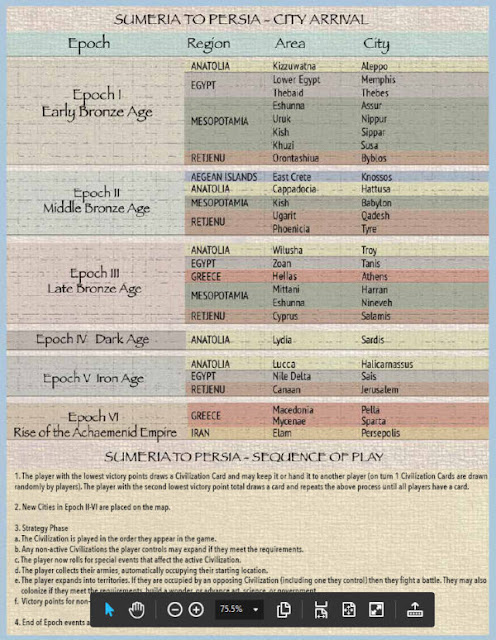
 This is the games sequence of play:

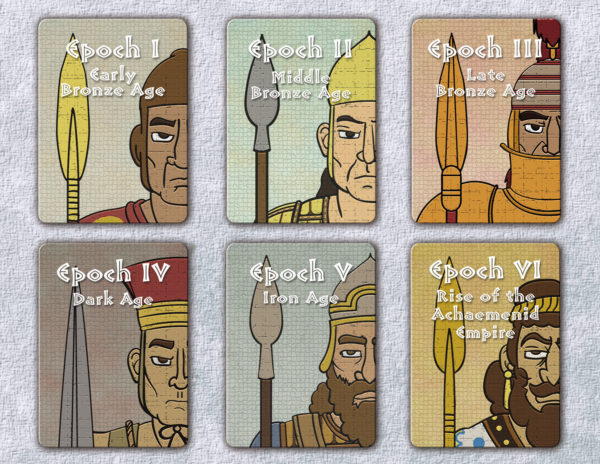
The game is played in six Epochs (or Turns). Each Epoch is 
divided into three phases:
 1) New Civilization Allocation Phase
 2) Strategy Phase
 - Player Civilization Rounds
 - Player Scoring
 3) End of Epoch Phase

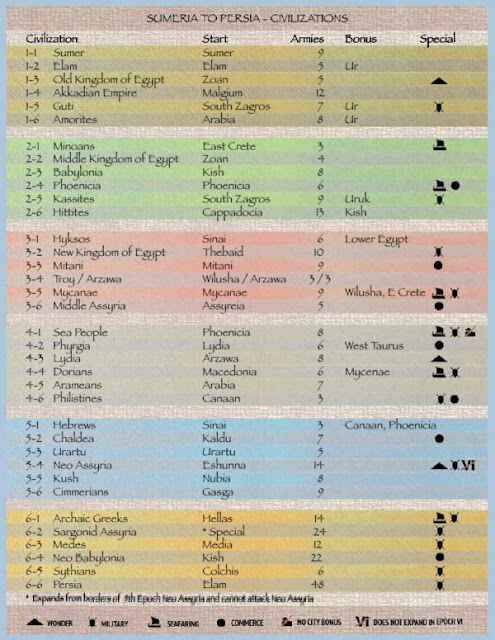
Sumeria to Persia was not really the type of game I thought it would be. It does have civilization growth and fall in it. However, it is also a game about conquering territory, which is right up my alley. My favorite part about the game is its sheer scope. I have seen games that had ancient Egypt, Babylon, and Israel in them as playable. have you ever seen a game where you could play the Mitanni? Here is a list of some of the nations/city states that you can play:

Sumer 
Elam 
Old Kingdom
Akkadian Empire
Minoans
Hittites
Hyksos
Mycenae
Troy
Assyria
Sea People
Urartu
Archaic Greeks

 Besides conquering, you also get Victory Points for building a Wonder, colonization, and advancing your culture. To try and build a Wonder you must take one of your armies out of play and challenge the fates with a die roll. 

 Once again, Compass Games has taken me to a place I never really had interest in before playing this game. Then they didn't just take me there, but ensured I had fun doing so. 


 Naturally, because of my wargaming bias, I prefer to play Alexander vs Darius. That is not to say that Sumeria to Persia is not a good game. The Epochs that it represents, especially the early ones, I am extremely interested in from a history point of view. How the 'Land of Two Rivers' became so important to the budding world is great stuff. Thank you, Compass Games for allowing me to review both of these games. I was very interested when I found out Sean Chich was one of the designers. I have a good number of his other games, and I felt with him you cannot go wrong, at least so far. On the games' websites below you can read both of the Rulebooks of the games. Peruse the site at your leisure. I have a ton of their games, and am in the queue for a good many more. 

Robert

Cradle of Civilization:

Compass Games:

While you are at Compass Games check these two upcoming games:


I am drooling over both of them.


  SOLDIERS IN POSTMEN'S UNIFORMS FROM DAN VERSSEN GAMES If by any chance the company Dan Verssen Games or the games designer David Thom...

SOLDIERS IN POSTMEN'S UNIFORM SOLDIERS IN POSTMEN'S UNIFORM

For your Wargamer, Toy soldier collector, MiniFig collector, military history nut. Reviews, interviews, Model Making, AARs and books!

 SOLDIERS IN POSTMEN'S UNIFORMS

FROM

DAN VERSSEN GAMES


If by any chance the company Dan Verssen Games or the games designer David Thompson are unfamiliar to you then you're in for a Christmas treat.  If you are familiar with this combination and haven't bought this game, then there may just about be time to make up for that lack and get it on your immediate Christmas list.

This is the third  design in he Valiant Defenders Series that began with Pavlov's House {PH}and was followed by Castle Itter [CI].  As such it is much closer to the latter than the former in scale and system.  It also continues David's Thompson's ability to find and focus on little known, but fascinating small scale encounters.  The first thing that intrigued me was the jump from the very end of WWII to the very first day of that war.

The game takes us to a desperate situation in the city of Danzig [now Gdansk] on the first day of the German forces' invasion.   Polish Post Office No. 1 was one of two locations with orders to defend and the game covers the single brutal day of its defence.  Unlike C.I. where you know that the outcome for the historical defenders was one of victory, this game is overshadowed by the knowledge that the historical day will end with the post office set on fire and the surrender of those surviving.  As with other of David Thompson's designs, there is an excellent companion booklet available to buy or download, as well as fascinating and extensive design notes.

Though much closer in appearance and design to C.I, Soldiers In Postmen's Uniform has a number of significant differences that make for deeper and more thoughtful game play.  This is reflected in the board and layout.

The left half presents the sort of aerial view used in CI; in the foreground is the L-shaped post office with a number of variously coloured tracks to show the advancing routes of the attacking German troops.  The right half is a schematic layout of the interior of the post office designed to show clearly the three levels - basement, ground floor and upper floors.  

As with the previous two games, the colour-coding between the two halves of the board provides the exact LOS [line of sight] correspondence that makes targeting so easy.  Nearly all the other physical components echo the previous games both in design and usage.

Square counters are used for the defenders, with the person's picture and name, accompanied by various data essential to game play.  These are mainly combat value, morale adjustment and special actions and attributes.  The colour of border to each counter distinguishes whether they are trained or postal workers or non-combatants.

The German units divide into circular Assault counters and square Support counters and, as always, there are numerous tokens covering action, disruption, suppression and movement along with morale, defence, weapons and ammunition tokens.  Finally there are the many cards that drive the German actions.  So far, so familiar for those who have the previous games, but I would say that even for those wholly new to the Valiant Defenders Series, this is still a very accessible system.  

All set up ready to play!
The structure of each turn remains the same: an Enemy Phase, a Defense Phase and a Clearance Phase. The Enemy Phase is the German A.I. phase governed by the draw of cards and then the Defense Phase is your player turn.  The main new development is that the whole game is now divided into three Attacks: Morning, Midday and Evening with three separate German card decks, one for each Attack.  Through the cards drawn either Assault units or Support units will be placed and various types of fire may occur.  The former are the round counters that include units such as leaders, riflemen and machine gunners.  As usual a die roll will place them on the initial  space of one of the four different coloured tracks.  Should that be occupied, it will cause each unit already on that track to move forward one space.
A closer  look at some of the punched units and markers

Several new details have been introduced.  The first is that not all of the four tracks are immediately in play.  This relates to the fact that the game divides into three Attacks, with the Germans taking different avenues of approach as the day drew on.  The second new element is that each track has an obstruction point.  When the first German unit reaches this barrier, it must stop and a new card the Grenade Bundle card is shuffled into the current Attack deck.  Any subsequent units will start to pile up at the barrier, until the Grenade Bundle card is drawn.

At that point a marker cube is placed to show the destruction of the barrier.  Following the logic of several other commentators on the game, I've reversed the process by placing the cubes to represent the barriers at the very start of the game and then removing each cube as the barrier is destroyed.  When the barrier goes, all the units that may have piled up at the barrier are pushed forward one space each.  
Rules explaining a breached barrier

Ultimately the Post Office will be breached and here comes the next most important change and one that introduces a whole new exciting level of action.  Previously that would be the end of the game - Defeat!  Now, the game does not end. Instead you play on until the last card of the current Attack deck has been played.  What then occurs depends on which of the three Attacks is taking place.

If it is Attack 1 or Attack 2 and there is at least one German Assault unit in the Post Office and one German Leader anywhere on the board, you shuffle all discarded cards and play through the Attack again until the end of the deck.  At this point check again. If there is no German Assault unit in the Post Office or there is no German Leader anywhere on the board, the Attack ends.  Having reached the end of an Attack, all adverse tokens, such as disrupted and exhausted, are removed and all your exhausted units returned to their fresh side, while German Assault counters are all removed from the board, but German Support counters remain.  Everything is then reset to begin the next Attack.

This new aspect of the game fuels a very different approach, where it becomes all important either to eliminate any attackers who enter the Post Office or eliminate every leader on the board by the end of an Attack.  The obvious outcome is that the game has the potential to take longer to play. This is counterbalanced by the introduction of a new "sudden death" defeat based on your morale level being forced down to zero.

However, should you have avoided a morale defeat and reached Attack 3, there are specific set up rules for German units and a special card introduced - the Fire Truck - which is shuffled into the final Attack deck according to where you are on the morale track track.  When this card is later drawn, it heralds the last turn of the game including a one-off Escape Phase, after which victory points are added up. 

To round up the picture of the changes, the Defense Phase instead of just giving you 4 Actions allows 4 units to move and then 4 different units to take one action each.  Combat is slightly more detailed, with the need for ammunition and weapons.  Having a building with three levels and specific entrances, plus fighting taking place within the building all add small extra details which minimally extend the rules, while augmenting the engrossing game play. 

There is an even greater sense of tension with the apprehension that you are always on the brink of disaster and, I confess, disaster is all too often the outcome for me.  Should you wish to pitch it at an even more difficult level, there's an excellent set of Tactics Cards, one deck for each Attack.  With these and variable additional German forces being set up on board at the beginning of each Attack, you can go all the way to Elite difficulty [or what I call Fiendishly Impossible!]
The three Attack Decks and their corresponding Tactics Decks

I think you can see that I'm 100% sold on this new addition to the Valiant Defense Series.  Provided you don't suffer an early Morale defeat, game play is longer and does demand more thought than Castle Itter, but it does so with only moderately more rules.  For me David Thompson has racked up another huge success that deserves to be in your collection.

Once again great thanks to Dan Verssen Games for providing a copy of the game to review.


hpssims.com