second chance games

Search This Website of delight

I'll be honest, I've watched so much of Battlestar Galactica that I occasionally hear the sound of the DRADIS sca...

Battlestar Galactica Deadlock: Ghost Fleet Offensive Battlestar Galactica Deadlock: Ghost Fleet Offensive

For your Wargamer, Toy soldier collector, MiniFig collector, military history nut. Reviews, interviews, Model Making, AARs and books!


I'll be honest, I've watched so much of Battlestar Galactica that I occasionally hear the sound of the DRADIS scanning for Cylon contacts in my dreams. It's no surprise then that I can never get enough of content related to that show and universe, and BSG Deadlock continues to feed that hunger many years after the show has come and gone. Not only did Black Lab Games and Slitherine deliver a far better core product than I think anyone would have predicted, they have relentlessly updated and expanded the game for more than two years post release. The newest DLC, Ghost Fleet Offensive continues the second "season" of the game's story and content.


The 10 mission storyline continues the enjoyable blend of politics, intrigue, and warfare that you know and love from BSG. A brief amount of time has passed since the end of the last DLC "Resurrection" and you remain in command of the Galactica itself. Like in the previous campaign, this DLC uses a smaller version of the strategic map from the original game. This streamlines that portion of the game to the point of simplicity, which some may like and others not so much. The focus here is primarily on the story missions, with smaller side missions to gather extra funds and experience in between. You still need to manage resources, build ships, research tech, and keep the Cylon threat level under control, but there isn't the balancing act of defending a dozen worlds and spreading fleets across a large map. The story missions themselves are good fun and tell another piece of the Battlestar Galactica saga, the story of the Ghost Fleet, which was featured in the short Blood and Chrome series. Essentially, you'll be going on a deep strike behind Cylon lines, looking to strike a crippling blow to their war machine.


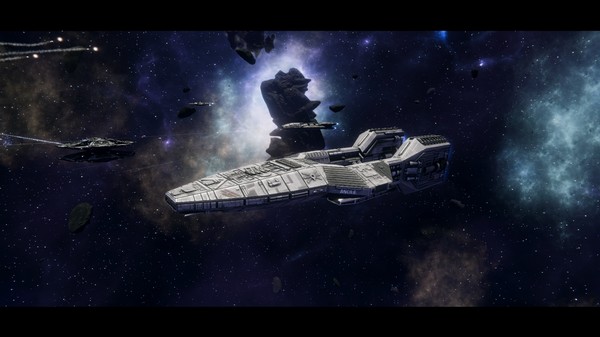
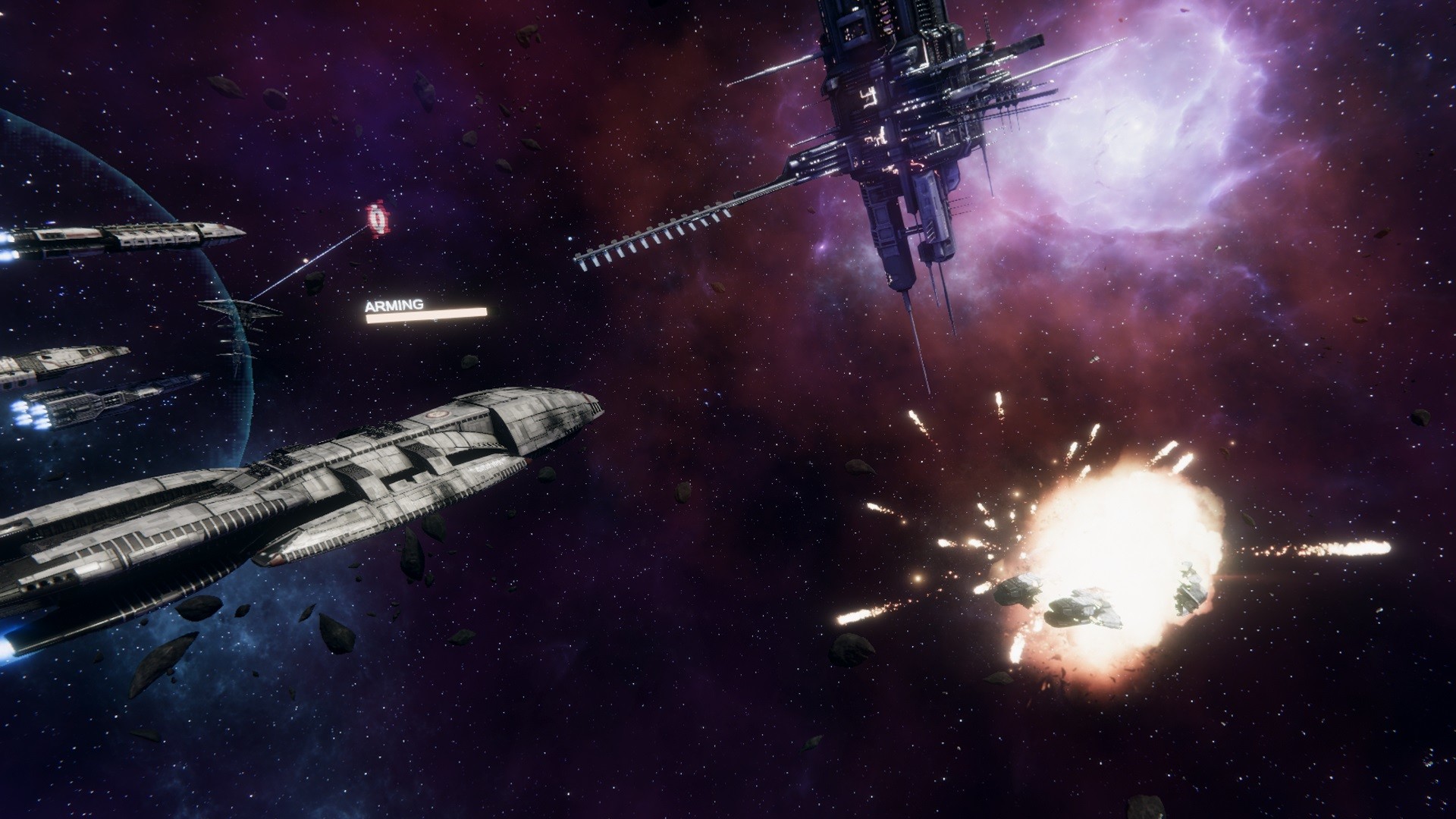
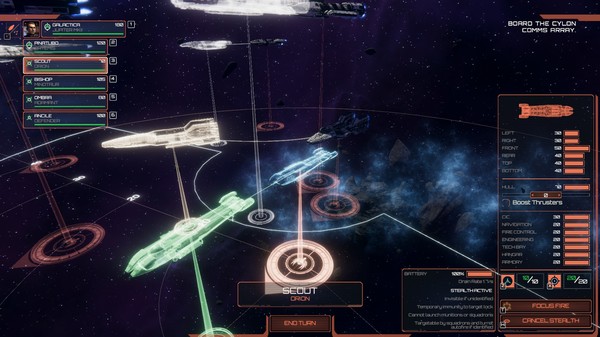
In addition to the new campaign, this add-on brings in several new ships, more toys for the toy box! For the colonials, there are two new ships. First, the Orion class frigate, which is able to use stealth tech to sneak in close for hit-and-run attacks. Second, the Defender support ship, which can send marines over to friendly ships to defeat boarding parties and boost their sub-systems. The Cylons also get a new ship, the Medusa, which can power up other Cylon ships around it and provide extra point defense cannons to take out your missiles and torpedoes. The Cylons are also packing some new heat in the form of virus mines that can disrupt your ships' systems, and cluster nukes that, well, you can imagine. Radiological Alarm! As with all the other DLC for Deadlock, more variety makes for more replayability and new tactical possibilities. 

Even if you don't pick up Ghost Fleet, you'll benefit from the continued development of Deadlock in the form of the free Fleet Admiral update. The most practical changes come in the form of UI tweaks and quality of life updates.  There is also the titular new Fleet Admiral difficulty level if you really want to challenge yourself. Some other nice enhancements are new portraits for your officers and the ability to choose the flagship of your fleet. 


For the price, Ghost Fleet offers a fair amount of new content, though it isn't game changing. There may be some players who aren't interested in the more linear campaign style here, and are waiting for some more of that open ended strategic gameplay from the core campaign. If you're like me though, you are deep enough into this game world that you'll want to pick this up just to keep up to date with the story and expand your ship roster even further. I give this DLC a solid recommendation and even more so recommend the core game if you have not picked it up yet. I think it continues to be a hidden gem mixing tactical space combat with an enjoyable strategic layer.

Ghost Fleet Offensive can be found on Steam and directly from Slitherine.


- Joe Beard 


Follow us Twitter @_AWNT_ or email me at beardjoe33@gmail.com


THE LAST VIKINGS from STRATEGEMATA You may be forgiven for experiencing the sort of confusion I had when matching the title o...

THE LAST VIKINGS THE LAST VIKINGS

For your Wargamer, Toy soldier collector, MiniFig collector, military history nut. Reviews, interviews, Model Making, AARs and books!


from

STRATEGEMATA

You may be forgiven for experiencing the sort of confusion I had when matching the title of this recent game from Strategemata with the picture on the box cover and the dates of the two battles. A thorough read of the extensive historical section of the Scenario book provides a description of the Swedish aggressors as "modern Vikings", though I feel the label fits a little loosely!

Still, what I have learnt, however, is that we're in the early days of the Great Northern War that marked the beginning of the C18th and embroiled Sweden, Denmark, Saxony, Poland, Lithuania and Russia for twenty years from roughly 1700 to 1720.  In other words, a period that many of us know very, very little about.  

The designer, Slawomir Lukasik, began this system by venturing into the slightly later period of the Wars of the Austrian Succession with a more familiar figure, Frederick the Great, and the game entitled, Bloody Fields of Mollwitz.  My own familiarity with the system stems from elements of it featuring in his game, Bloody Steppes of the Crimea, which took us on to the more familiar battles of the Crimean war in the 1850s. 

My review in August 2018 of the latter game raised some issues both of physical production and rules clarity.  I'm very pleased to say that, in the main, this new game has stepped up the quality all round.  The standard sized double-sided map, though only slightly thicker, is significantly better in appearance.  In part, this is mainly because of the removal of the heavily obtrusive hex numbering. Instead, set up is printed on the map so lightly that it is has no adverse impact at all during play.


The Battle of Kliszow - opening set up


As the main scenario, the battle of Kliszow, is a substantial and lengthy game to play, this may have a drawback in that it makes recording a game more difficult, if you cannot leave it set up.  Nevertheless, the trade off in visual appeal is well worth the minor inconvenience.  The package is greatly improved too by the inclusion of fine, full-colour set-up displays for this main battle.
 A similar display is provided for the very useful introductory Scenario, while the battle of Fraustadt, being much smaller in scale than the battle of Kliszow simply needs no more than the set up printed on its map.


The reverse of the box showing the map of the Fraustadt battle with the set-up unit displays printed directly on the map.  


On the reverse of two of the displays are separate copies of the charts for melee and fire combat that are also printed in the rule book.  Rather surprisingly the terrain chart is only printed on the back of the Scenario book, but a quick photocopy easily provides an extra substitute if needed.


Melee combat player aid

Regarding physical features alone, the unit counters and markers are a major step up in quality, both for thickness and visual appeal.  The colour identification for the three Wings of each army, along with in many cases their being only a single number on a unit, are also a great help to ease of play and the attractive presentation.

One of the excellent display cards for set-up

Finally, the Rule book and Scenario book too round off the overall improvements in quality.  Being still only simple printed black and white paper and stapled, they lack the big publishing companies flourish.  But the slight increase in text size has made a huge difference to the ease of reading them.  Overall the accuracy of the English translation is very good, occasionally prepositions still cause a few pauses to make sure you've grasped the intent correctly and only one sub-heading PERFORMING EVOLUTIONS stands out as missing the mark, in the rules about changing facing. REVOLUTION is presumably the preferred word and even that doesn't quite fit the bill.

As with previous games that use this system or modifications of it, the sequence of play is very interactive.  Both sides have one Activation marker for each of its Wings in the battle and the turn progresses with each player secretly choosing one of those markers.  An Initiative die roll, with appropriate modifiers, determines the Initiative player, who will decide whether he/she goes first or second.  If second, they can keep their choice secret until after the first player has moved and conducted any combat.
This interchange of paired initiative choices continues until all of both players formations have ben activated.

A sequence of Command chain for leaders and their related formations continues to be one of the strong elements that I like very much.  It is clearly explained and works smoothly in combination with the assignment of orders.  Both melee and fire combat are possible, but a unit may only ever engage in one of the two when activated and melee is only possible under Assault orders.

Combat remains the longest and most detailed section of the rules and once again takes careful reading and practice to ensure both understanding and accurate practice.  Of all the details of combat,  the one I find most intriguing is the importance of morale which is the main and, in many cases, the only number on a unit counter.  Not only does it play the predominant role in melee, but it is these factors that are lost by a unit whatever the type of combat and recorded by placing a morale strength marker under the unit.

Many factors affect morale so that units rapidly decline in their power to function effectively.   However, when activated a unit may recover some degree of morale depending on several factors including the current orders the Wing is under and position in relation to enemy units.  Appropriately, the more aggressive your orders the fewer morale points you are likely to recover.  So, a Defensive posture allows you recover a unit's starting morale level by staying in place and expending all its movement points. [thanks to Adam for pointing out the mistake in my original comment here.]

All units, except artillery, have two steps and a unit routing or losing 3 or more morale points in a single activation is flipped to its weakened side or eliminated if already on its weakened side.  Similarly, a unit whose morale is driven down to zero is also eliminated.  In specific circumstances, a unit may be eligible to be returned to the map at a level of 1 morale point.

As is to be expected for the period, facing is important for a number of familiar reasons: including determining ZOCs, whether a unit can fire or assault [orders too play a part] and the effects of flanking or being flanked.

In getting to grips with the rules, I'd strongly recommend the following sequence.  First of all skim the rules to get an overall idea of the concepts and then place a few units on the map while carrying out basic rules of Fire and Assault.  From there, proceed to the very short Introductory scenario which is played out on the Fraustadt map.  Next, play the full Fraustadt battle and finally [and by now I hope familiar with the system] move on to the major battle of Klitszow.

The Scenario book at first sight looks daunting because of its length, but I'm glad to say that this because16 pages of it is a detailed historical narrative. The specifics for each scenario are very manageable.  As I am not a great fan of scenarios that introduce a substantial number of extra rules, modifications or exceptions, it was a relief that even the largest scenario introduces only easily accommodated additions.

In conclusion, this is a detailed system which I would recommend to gamers familiar with the language of board gaming and especially those who have a taste for the musket and pike era.  Turns can be quite long once opponents get to grips in combat, but both players are actively involved in the interaction that ensues.  It is an attractive package that marks a good step forward in the quality of the components, especially the counters which are very attractive, colourful and easy to read.  On the maps they stand out well and the overall effect is visually complementary, as can be seen in this view of the battle of Fraustadt.


Once again, it's thanks to Strategemata for providing the review copy and for their success in opening up this period to us.

Average cost

USD 60

£57.95

"Paladins of the West Kingdom is set at a turbulent time of West Francia’s story, circa 900AD.  Despite recent efforts to develop ...

Paladins of the West Kingdom Paladins of the West Kingdom

For your Wargamer, Toy soldier collector, MiniFig collector, military history nut. Reviews, interviews, Model Making, AARs and books!


"Paladins of the West Kingdom is set at a turbulent time of West Francia’s story, circa 900AD.  Despite recent efforts to develop the city, outlying townships are still under threat from outsiders. Saracens scout the borders, while Vikings plunder wealth and livestock. Even the Byzantines from the east have shown their darker side. As noble men and women, players must gather workers from the city to defend against enemies, build fortifications and spread faith throughout the land.  Fortunately you are not alone. In his great wisdom the King has sent his finest knights to help aid in our efforts. So ready the horses and sharpen the swords. The Paladins are approaching."
Rule book introduction

Gameplay

Paladins of the West Kingdom is not your typical worker placement game. Normally you’re denying action spaces to other players on a shared board.  Paladins gives each player their own board on which to place their own supply of workers.  A criticism often levelled against worker-placement games is one of being multiplayer solitaire, and that is definitely the case here.  However, the game is that crunchy, that I feel increasing the interaction between players would actually lessen the overall game and I am happy that my opponents aren’t able to thwart my well-considered plans (too much).  

The game is played over seven rounds in which all players will be taking multiple actions with their supply of workers.  Each player will take as many actions as their workers permit and there are often clever ways to combine effects and abilities to increase the amount of workers during your round.  If you don’t mind a bit of analysis paralysis, then you will be able to work out an optimum round. However, this game continues to reward my impulsive play; I often realise possible combinations half-way through my turn and I have been able to exploit it immediately.


Player board at the start
Aside from the player boards, there is an elongated main board which holds a variety of King’s Orders and King’s Favour cards.  Each game will consist of 3 Orders and 6 Favours and there is twice this number provided in the box.  This means that the focus and overall objectives of each game will be different.  I have played this a number of times now and in each play, the different cards and sometimes order in which they’re revealed, significantly change the game and keep it feeling fresh.

Each player has their own deck of Paladin cards from which you’ll select one to be your Paladin for the round.  The selection mechanism is quite clever as you’ll know one of the Paladins which will be available in the next round (from a choice of 3).  I’ve tried to plan current turns to optimise my next turns’ Paladin but for some reason, either lack of brainpower, or just getting sidetracked by the number of options, I don’t think I’ve ever managed to exploit this.  However, I like the mechanism and look forward to trying again.


Main Board at the Start
There is also a shared pool of Tavern Cards which are chosen individually by each player.  These combine with the chosen Paladin card to give players the workers shown on both cards to use for the round.  This will normally be 6 workers of various colours unless you passed in the previous round and kept workers to use the next round; I have started a round with 9 workers. There are a few spaces on your board which only require one worker per action, but most require 2 or more workers.  You can feel like you’re burning through workers quite quickly, particularly at the beginning of the game.

One of the best aspects of this game is that you’re able to change the requirements for some spaces through the use of Workshops.  If you take the time to Develop your board you can reduce some 3-worker spaces down to 1-worker spaces.  This is crucial to stretching your turn and giving you more actions each round.  However, you won’t get very far by just building workshops, the most Victory Points come from focusing on the attribute tracks at the side of the player boards.


Green Workshops (being ignored)
Three attributes (Faith, Strength and Influence) are measured per player and drive the whole game.  Most spaces require a certain amount of one of these attributes in order to place a worker there, however, there is usually a reward in another attribute. For example, if you wanted to attack an Outsider I would need to have a specific amount of strength and I would be rewarded with Influence.  Although this is a pure-worker placement game, the game and its actions do make sense thematically, if it is a little loose.  I still can’t quite work out why, when I pay tax I am taking money from the Tax Supply.

Not only are there attribute requirements but there are also worker requirements, for example, a red space requires a red worker.  There are 6 different types of worker in the game and the right colour must be used on a coloured space.  An outlined space can take any colour worker. However, the purple worker (a criminal) breaks this rule and can go on any space, coloured or not (apropos yes?).  These colours are defined as red-fighter, black-cleric, green-scout, blue-merchant, purple-criminal and white which is a generic labourer.  These colours also are linked thematically to their corresponding action spaces, for example, the Pray action requires a cleric, (arguably the only space that you should definitely use each round).


Absolve, close-up 2 Clerics and a Merchant.
There is very little downtime for any player unless you’re the first player to pass early in a round and your opponents still have a handful of workers left.  If so, you’re likely doing something wrong and that is probably only your fault.  However, this downtime could only be 5 minutes at the absolute most.  Normally I would expect your turn in a four-player game to come round within a minute or two.  You will be involved and thinking about your turns or taking your turns right to the end of this game.   Your success and failures of the consequences of your actions alone and that is something which I like. 

The are several mechanisms through which you can affect other players games however none do so significantly.  You’re limited to just denying certain cards or spaces from your opponents, but there will usually be other cards (and spaces) still available.  I don’t think you would be competitive if you were playing to hurt your opponents instead of playing to benefit yourself.


End-game main board - there are still open spaces.
It is quite difficult to determine which player is ahead until the end-game scoring through which there is a veritable point salad available to players.  I found that games where I thought I was romping home and clearly ahead (in points) were actually much tighter.  Even if you think you’re well behind on scoring, I’ve found that the scores have been tight and I’ve not been able to deduce from glancing at all the player boards who the leader is.  Players score points from a wide variety of cards and board spaces which can really only be calculated at the end.   This keeps all players involved in the game right to the end.


Components

The art design throughout the game shares the same distinctive style used in Architects of the West Kingdom and the third game in this trilogy, Viscounts of the West Kingdom.  The wooden components are great and there are approximately 200 of them in six different sculpts and seven different colours. There are also approximately 100 cardboard components which weren’t just standard circles and squares and they all punched cleanly.


A perfect fit
Once you’re familiar with the rules and actions there was/is little need to refer back to the rulebook. The iconography on the board is intuitive and consistent throughout the game.  Each action space is sufficiently described on the board to allow new players to grasp the rules within about 20 minutes.

What is great (in terms of components) about this game is the box size.  I have seen negative comments about the box size and some people finding it difficult to get all the components back into the box.  When the game is all bagged there is literally no free space left in the box, to my mind that is a perfect box size. However, I can understand if you’ve sleeved your cards then you would struggle.


Criticisms

The biggest criticism I have is one of table space.  Although the box is deceptively small, what comes out of it is ravenous in terms of its appetite for tablespace.  The mainboard is long, (but thin) and around that there will be at least six different areas for card decks and tableaus.  Each player board is a more typical size of player board but again you’ll need space around the sides to place recruited Townsfolk cards, converted Outsiders and any successful attacks in their own face-down deck.  That's without storing your workers, provisions and money. I can’t recommend this game if you’re table is on the small side.


A deceptive table-hog.

Conclusion

This game ticks a lot of boxes for me; it’s fairly crunchy with lots of interactions between your own resources and attributes.  Affecting them in positive ways and the decision to focus your efforts on one over the other is a nice decision space.  Fortunately, other players aren’t really able to affect your own path to victory too much and in this game, that is a good thing.  It would be intensely frustrating to have your plans ruined by another player's actions purely by chance, and in this game, I feel that you’re not able to play to hurt your opponents; there’s too much going on, on your own board to be concerned with your opponents. 

There is very little downtime throughout the whole course of the game and after two hours you do feel as if you’re brain has had a good work out.  Of course, you could just go along for the ride and select actions with no clear purpose, just to see how the game works, but I guarantee that you’ll do terribly when it comes to scoring.  This game rewards, clever play and finding combinations to extend your turn, getting additional workers is critical for success. 


Set up takes about 10 minutes.
There are a finite number of components that will fit in any box and I’ll admit I’m amazed at how much they’ve managed to cram into this box.  But due to the King’s Orders and Favours changing each game, the tactics and strategy that were successful in your previous play won't necessarily be successful in your next.  After your first game, which will just be a learning game, you’ll have a wide array of tactics to consider each turn which will be different each game.  This game has high replay value. 

I’d like to thank Asmodee for sending this review copy.  Many local game stores will still have this in stock and you can use this link http://www.findyourgamestore.co.uk/ to support your FLGS or use their online shopping web store. 

Publisher: Garphill Games
BGG Page: https://boardgamegeek.com/boardgame/266810/paladins-west-kingdom/
Players: 1-4
Designer: Shem Phillips, S J Macdonald
Length: 90-120 minutes

Operation Crusader Tank Warfare in the Desert, Tobruk 1941 by Hermann Büschleb translated by David Dorondo ...

Operation Crusader: Tank Warfare in the Desert, Tobruk 1941 by Hermann Büschleb translated by David Dorondo Operation Crusader: Tank Warfare in the Desert, Tobruk 1941 by Hermann Büschleb translated by David Dorondo

For your Wargamer, Toy soldier collector, MiniFig collector, military history nut. Reviews, interviews, Model Making, AARs and books!


Operation Crusader

Tank Warfare in the Desert, Tobruk 1941

by

Hermann Büschleb

translated by

David Dorondo


  This is an extremely interesting, if short, book at less than 100 pages. Hermann Büschleb was a staff officer in the Germany Army during WWII. The book was apparently written for the United States Army. After WWII, Hermann Büschleb became a Major-General in the West German Bundeswehr. The jacket states:

"Writing in the 1960s, Büschleb framed his account of Crusader as a case study, almost an instruction manual for the leadership and command of armored and mechanized warfare. He intended it to be of practical use to contemporary military personnel, who expected to fight a similar type of warfare against the Warsaw Pact."

 The first thing you will notice when opening the book is that it comes with twenty-one maps of the action before and during Operation Crusader. The background and "Situation in Context" of the battle take up the first twenty-eight pages. The length of the German supply line, and the reduction in the ports available to the Italo-German were only the first two problems.  The active British intervention against their supply lines was the third and most dangerous threat to the Italo-German supply. With the amount that the author tells us of supplies that got through, it is amazing that the Italo-German forces were able to eat let alone fight. 

 The actual course of the battle takes up the next forty-seven pages. This gives an almost minute by minute breakdown for the engagements that took place. The majority of the action follows the Deutsches Afrikakorps, although the author also mentions some of the Italian actions. The author's three page "Conclusion", which is divided into "Historical Considerations" and "Tactical Considerations", are concise but right on target. 

 This book is probably the best German Officer written appraisal of a battle in WWII that I have read. Many that I have read are tough to slog through, but this is written as well as the better histories are. I am not sure if this is because of the translator making it slightly more appealing, or does it come across the same way in the original German. Whichever, it works superbly. Thank you Casemate Publishers in allowing me to read this concise, but well done appraisal of Operation Crusader.

BooK: Operation Crusader: Tank Warfare in the Desert Tobruk 1941
Author: Hermann Büschleb
Translator: David Dorondo
Publisher: Casemate Publishers

Robert
hpssims.com