second chance games

Search This Website of delight

  Imperial Tide The Great War 1914-1918 by Compass Games   There was always a dearth of World War I games. Because of the nature of the West...

Imperial Tide: The Great War 1914-1918 by Compass Games Imperial Tide: The Great War 1914-1918 by Compass Games

For your Wargamer, Toy soldier collector, MiniFig collector, military history nut. Reviews, interviews, Model Making, AARs and books!


 Imperial Tide


The Great War 1914-1918


by


Compass Games


  There was always a dearth of World War I games. Because of the nature of the Western Front trench system many players and designers stayed away from gaming the war. Oh, here and there were excellent games on the subject, but never the amount that the war deserved. In the last few years that has thankfully changed. Compass Games is mostly to thank for this change of events. They have released a large number of games, from the strategic level on down to the tactical level. These are:


 On the Strategic level:

The Lamps are Going out: World War I, 2nd Edition

Balance of Powers

An Attrition of Souls

Empires and Alliances

Europe in Turmoil, Prelude to the Great War


Tactical Games, The Red Poppies Campaigns:

The Battle for Ypres

Last Laurels at Limanowa

Assault Artillery


 Solitaire Games:

Raiders of the Deep: Uboats of the Great War 1914-1918

Zeppelin Raider


Do not forget these two that are coming up:

Western Front Ace1916-1918 - Solitaire

Death in the Trenches - Strategic


 They also carry this game from Australian Design Group:

Fatal Alliances - World in Flames game set in World War I


 This is what comes with the game:


One Rulebook

Two Counter Sheets with 216 Counters

One Solitaire Play Aid Card

One 22" x 34" Mounted Map

One Deck of 51 Cards

Two six-sided Die

There are three types of cards. These are Year, Central Powers, and Allied Powers cards.


 Sequence of Play:


Alternate card play or resource expenditure play. The first player is noted on the year card.

When both players pass without having played a card or used a resource point, the year ends.

At year end, any besieged forts are destroyed. Out of supply units surrender and are removed from play.

Put the next year card in the year card box. Zero out all resource points. Place new resource points per the new year card.

Receive the new year's cards for free and spend build points to rebuy previous cards.

Shuffle all the purchased, held, and new cards face down, deal two into two piles, and choose one pile randomly (or take the larger pile if uneven). The next turn starts.


  Let us take a look at the components. The Mounted Map is very nicely done. It uses point-to-point movement so there is not much terrain on the map except for major rivers. The terrain for each point is at the bottom of each movement box. This makes it simple with no confusion. The Map also has all of the charts on it. So, you do not have to worry about off map sheets with tables. If you have room for the map in your playing space, you are good to go. There is only one Player Aid Card and that is for playing solitaire. A solitaire 'bot' or way to play is quickly becoming a must in our hobby. The Player Aid Card is two-sided and is made of hard stock. The Rulebook comes in color and is only thirteen pages long. It is easy to read and is written so that you will be up and playing in no time. There is also a page of a play example of the first year. The last page has the Designer Notes. I, like many others, love to read the thoughts of the designer of my games. The next part up is the counters. They are color and flag coded. They have generic numbers on them for strength, and they are large. They will pop out of the sprues in a small breeze and are pre-rounded. It might not seem like much, but the other day I bought an older game and was forced to pull out the old scissors and cut apart two counter sheets of small counters. I believe I now have Carpal Tunnel in my other hand. Compass Games components are some of the best in the marketplace. After dealing with the older counters, I was just so thankful that these counters were so easy to deal with. Next up is the Cards. These are your standard game size cards and have well done pieces of art on them. They are easy to read and simple to figure out. 


  So, what we have so far is: a strategic World War I game with very good components and a short, but informative Rulebook. It is a simple to learn game that has many nuances. The rules make you feel that you are playing a World War I game and not pushing Panzers around the map. By that I mean that is does not seem cookie cutter in play. Playing either side you will be forced to deal with the realities of early 20th century warfare. Naturally, this would be as the designer sees it. This game adds in the ability of both sides to use 'Attrition Combat'. This effectively just inflicts casualties on your opponent, but also yourself. However, this was used throughout World War I as a viable strategy. The game also uses Resource Points for each country in every year of the war. The design is meant for the player to use the Resource Points as an Operational Reserve for whatever use they are needed. 


 This is some of what Compass Games has to say about Imperial Tide:

"The core of the game is the unique card re-buy system, in which players take their annual production (adjusted for U-boats, blockades, and Zeppelin bombing) and decide which cards they need for the upcoming year. Cards not only provide for reinforcements, but allow for movement, combat, and entrenchment. Which cards to rebuy is without question one of the key decisions the player must make to prepare for next year’s operations.

The game has infantry units for all of the major participants, and artillery “units” actually represent stockpiles of ammunition to be used for offensives. Naval operations are mainly abstracted, although sea movement to Salonika and Gallipoli is allowed."


   The cards for each side explain to the players what effects they will have on play. These are some of each side's cards:

Central Powers:

Verdun
Poison Gas
U-boats Attack
Zeppelin Attacks

Allied Powers:

Messines Mine Attack
Miracle of the Marne
Brusilov Offensive
Salonika

The Year Cards show how many Build Points each side gets, along with their Resource Points.


 The gameplay is fast but deep and gives the player a lot of different options, while still putting on him the constraints of a commander in World War I. The designer, Gregory M. Smith, also designed the game Pacific Tide. So, if you are familiar with that game the learning curve is almost nil. Mr. Smith was looking to design a fun game that was playable in under three hours, along with sufficient depth to keep the players interested. I believe he has done just that.

 Thank you, Compass Games for letting me review this game. The next game I will be reviewing for Compass Games takes us back to the 18th century. It is 'War for America: The American Revolution, 1775-1782'. 

Robert

Compass Games:

Imperial Tide: The Great War 1914-1918:


  The Grass Crown by Hollandspiele   The Grass Crown was the Roman Republic's highest honor. It was given for actions that saved a legio...

The Grass Crown by Hollandspiele The Grass Crown by Hollandspiele

For your Wargamer, Toy soldier collector, MiniFig collector, military history nut. Reviews, interviews, Model Making, AARs and books!


 The Grass Crown


by


Hollandspiele


  The Grass Crown was the Roman Republic's highest honor. It was given for actions that saved a legion or the entire army. Some of the Romans honored with it are: 

Quintis Sertorius

Scipio Aemillianus

Lucius Cornelius Sulla (Felix)

Publius Decius Mus (received two Grass Crowns)

 The Grass Crown continued through the whole of the Republic to be thought of as the greatest achievement of a Roman. That is, until it was sullied and thrown in the mud when it was given to Octavian for being Caesar's heir or throwing up the most in his tent during a battle (sorry, just a bit bitter). This is why Hollandspiele chose the name The Grass Crown for their second game in the 'Shields and Swords Ancients' series. The Grass Crown is about battles during the Roman Republic.


Contents


 This is what comes with the game:


17" x 22" Mapsheet

(3) Countersheets

28-page Rulebook

12-page Battle Book

A Brief and Digressive (But Mostly Accurate) Military History of the Roman Republic, With Jokes, a 28-page supplement

(2) eight-sided dice


 This is the Hollandspiele write up about the game:

"This second game in the Shields & Swords Ancients series recreates ten battles spanning nearly three hundred years of Roman history. As was the case with the first game, With It or On It (2019), The Grass Crown is a fresh, innovative taken on familiar material. The primary unit of maneuver is a "Wing" which itself consists of ten or so individual counters. Losses can be resolved by flipping the individual unit that was attacked, or by flipping any unit adjacent to it. Unrelenting pressure in the right places can prompt a Rout Check, causing the line to collapse. As the result of a single attack, multiple units can find themselves in your dead pile.

This simple but compelling theme sees many variations thanks to special rules that chart the evolution of Roman warfare, and contrasts them with the rigid Greek Phalanx, the sophisticated army of Hannibal, and the ferocity of the Gauls.

The ten battles are: Heraclea, Asculum, Trebbia, Zama, Pydna, Second Citra, Vercellae, Pharsalus, Thapsus, and Munda."


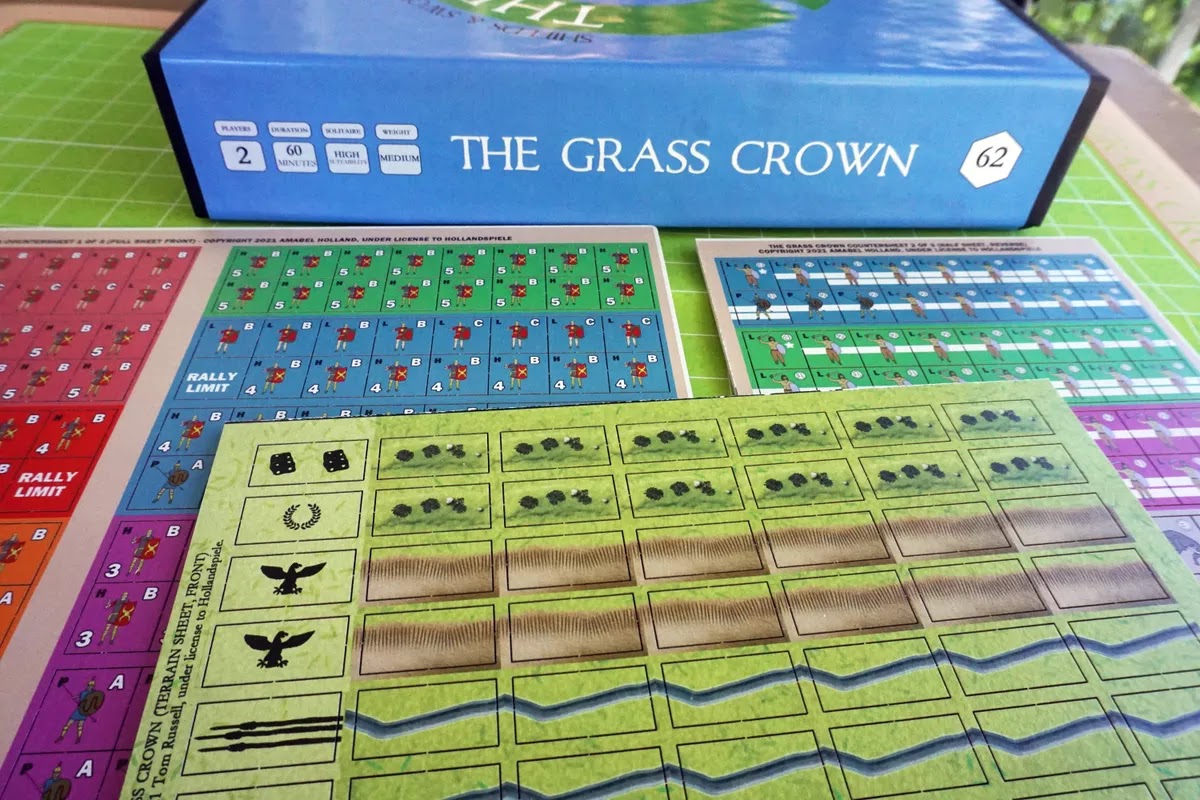
The three counter sheets

 So, we have two battles with Romans against Pyrrhus. Then two with Romans versus Hannibal. The next two battles are of Romans versus Jugurtha in North Africa, and then against the Cimbrians. The group of ten is rounded out by three battles of Caesar versus the Republicans (Pompey, and Cato etc.). I understand the choice of battles, but I would have preferred to have one where Sulla is in charge and not just an underling to Marius (wow, that puts a bad taste in my mouth). The battles show the Roman Legions against a wide variety of different enemies. They face phalanxes, barbarians, and then other Romans, with various allies. I would also have liked to have Magnesia in the group, but it is essentially another battle against phalanxes. The game is also setup like the almost fifty year old SPI PRESTAGS games. Meaning, that with some reading you can come up with forces to play out any battle you want from these eras. 


 The components are your typical Hollanspiele ones. This means that we are going more for functional, rather than pieces of artwork. The map is a terrain free green one, made up of squares instead of hexes (more on this later). The counters are large at 9/16", and are both color and alphabetically coded. They are not 'busy' at all, and are very easy to read. The Rulebook is twenty-eight pages long and the insets are in color. The Battle Book is twelve pages long, and has the setups for the different battles. The last page of both the Rulebook and the Battle Book has the Sequence of Play, Combat Results Table, and other reference material. The Military History of the Roman Republic is twenty-eight pages long and is worth the price of the game alone. The illustrations in the book were done by John Leech (1817-1864). He was known for his work in the magazine Punch. They were originally used in the book 'The Comic History of Rome' published in 1851. They, and the writing, are hilarious. While the author, Amabel Holland, has her tongue firmly embedded in her cheek, it is nonetheless an accurate history. I read a history book of Rome by Isaac Asimov, and it is just as informative and entertaining as his book was. The components are all up to snuff. So, what about the game itself?


 As was mentioned, this is the second game in the 'Shields & Swords Ancients' series. After a while I fell in love with the first design. The non-use of hexes threw me at first, but it made a ton of sense in the end. You cannot expect phalanxes, or legions, to operate as 21st century skirmishers. 


  The first game, 'With It or On It', was about battles in Greece before Alexander the possibly Great. So, besides two battles that had the Persians in them (Plataea and Marathon) it was phalanx versus phalanx battles. The designer explains that the rules had to be increased for this game because of the difference between battlefield tactics and changes compared to the older battles in the first game. This game does show the growth and change that took place in the legions between the time period shown. Marius's Mules are much more competent and deadly than the Roman Armies faced by Pyrrhus, and possibly Hannibal. Rome was an eclectic society one all levels. Be they Gods, or battlefield tactics. The manipular legion though can be placed at the feet of Roman intellect, and it enabled them to rule most of the known world. 


 This is the Sequence of Play:


1. Command Phase

2. Action Phase

    a, Skirmish Phase

    b. Rally Phase

    c. Move Phase

    d. Combat Phase

3. Victory Phase

4. Initiative Phase


  There is way more to this game than meets the eye. When you first open the box, you might be thinking that this is a beer & pretzels game. In no way, shape, or form, is this one of those. One of the best things about the scenarios and the rules is that you can see the progression of Roman battlefield tactics, and their actual formations. I absolutely love it when a game can teach a player something. This does not mean that the game is just a boring rendition of history. There is just enough friction of war put into the mix to make the battles seem fresh each time. I admit I am a sucker for anything that games the Macedonian phalanx against the Roman legion. This game lets you play out those encounters to see the strength and weakness of each of those formations.

 One of the many innovative rules deals with 'brittle' units. When checking in combat if a unit receives an exhausted result the owning player must turn one of his units, or that one, to its reverse side. If it has two stripes, it is a brittle unit and is immediately eliminated. Just when things seem to be going your way a bit of friction will reduce you to a Nervous Nellie.


 I want to say thank you very much to Hollandspiele games for letting me review this, and other, games. I want to especially congratulate Amabel Holland for her design acumen and her sense of humor. This series of games is a must own for anyone who has the ancients bug. I see on BGG that an expansion is already planned with more battles and different units. Please take a look at all of their games, but especially the 'Horse & Musket' series. You will find many battles that have never been gamed before.


Robert

Hollandspiele:

Hollandspiele

The Grass Crown:

The Grass Crown – Hollandspiele

With it or on it:

With It Or On It – Hollandspiele


  Tolling of the Bell by Three Crowns Games  This is a game about the 'last' German offensive in World War II. Seriously, this is th...

Tolling of the Bell by Three Crowns Games Tolling of the Bell by Three Crowns Games

For your Wargamer, Toy soldier collector, MiniFig collector, military history nut. Reviews, interviews, Model Making, AARs and books!


 Tolling of the Bell


by


Three Crowns Games


 This is a game about the 'last' German offensive in World War II. Seriously, this is the last one. Last German offensives seem to keep cropping up like the Energizer Bunny. The Battle of the Bulge is sometimes called the last, also Operation Nordwind has been talked about with that sobriquet. On the Eastern Front, Operation Konrad (the relief of Budapest) has also been called the Germans' last offensive. Well, here we have 'Operation Spring Awakening', the absolutely, positively last German offensive. Operation Spring Awakening was carried out by the Heer's 6th Army, and the 6thSS Panzer Army. There were two other operations that the Germans tried to carry out. These were 'Icebreaker' and 'Forest Devil'. Icebreaker was an attack by the 2nd PZ Army, and Forest Devil by Army Group E. In Hitler's mind these operations would be able to break the Soviet Armies in the south and the German forces would be able to not only do this, but recapture Budapest, and then continue to reconquer Romania. It is amazing what tertiary syphilis or Dr. Morell could do to the mind. 

 This is the fifth game the Swedish company Three Crowns Games has produced in their WWII Battle Series. The others were:

Army Group Narwa
Konigsberg '45
Starguard Solstice
Plan West

 They also created the game Pax Baltica. Pax Baltica was released in conjunction with GMT Games. Revolution Games carries Narva and Konigsberg. 

 This is what comes with Tolling of the Bell:

One 23.5" x 33" (A1) full color map
Two dual-side printed countersheets (286 9/16" (15mm) counters)
One 16-page rulebook
Two single-side printed Player Aid Cards


Rulebook


 This is what Three Crowns Games say about the game:

Game Scale:
Game Turn: 2 days
Hex: about 3 to about 4 km
Units: Battalion to Division

Solitaire Playability: High
Complexity Level: Medium
Players: 2+
Playing Time: 3-10 hours
Note: Players will need to provide one 6-sided die for game play.

"Tolling of the Bell is taught in 30 minutes and easy to digest yet a challenge even for the more experienced players.
It utilizes a Command chit-pull system to activate HQ, which in turn allow their controlled combat units to move and attack."


Historical notes on one side of the Player Aid Cards


 If you have any of the other four games, you will know exactly what the components will be like. The map is very well done and is on high gloss paper. The map is mostly of the area south of Lake Balaton in Hungary. The terrain is easy to see, and you will not have to decide what terrain is in each hex. The counters are done with vibrant colors and are easy to read. They are also thicker than most counters. The two Player Aid Cards are of hard stock and in full color. All of the information on them is easy to read. The Rulebook is sixteen pages long. The actual rules are only thirteen pages long. The other three pages are for the game's setup, Designer Notes, and Random Events etc. It does also come with some Optional Rules. The Rulebook is in black and white. The components are very well done for a game of this price. 


Test Game


 This is the Sequence of Play:

Air Unit Phase
 Refitted Unit Return Segment
 Grounded Unit Refitting Segment
Random Events Phase
 Random Event Table Roll Segment
Command Phase
 Command Segment
 Movement Segment
 Combat Segment
Supply Phase
Reinforcement Phase
 Reinforcement Segment
 Replacement Segment
End of Turn Phase
 Out of Command Segment
 Turn Advance Segment


 The game would be recognizable to a wargamer from the 1970s. Albeit, with a good number of newfangled bells and whistles. The chit pull system adds to the fog of war enveloping both players, along with the Random Events that are possible. This is a wargame that a Grognard can sink his teeth into. I certainly wouldn't transition someone from Axis & Allies right into this game. That is not a knock, it is a good thing. The more real Grognard games the better. The weather in the game is both historical and a bit odd for a game. The weather for the first five turns is going to invariably be mud, not really something you would expect in a game about Panzer operations. At least both sides suffer the same effects from it. 

 The game's Victory Conditions are based upon city Victory Objectives Hexes. Each city is assigned its own value. The Russians and Germans both start the game with ten Victory Point Objectives. There are also Sudden Death Victory conditions. The player has to have a unit that is in supply in these hexes at the end of a turn. These are:

German Player - They have to occupy one of the bridge hexes across the Donau at either Dunafoldvaar, Baja, or Ercsi. 

Russian Player - They have to occupy either Nagykanizsa or Papa.

 The Tolling of the Bell is a very well-done wargame. Naturally, with it taking place in March of 1945 leads the German player having to do better than their historical counterpart. The German player is not going to be able to blitz his opponent, especially in the mud. As the German player you will need to play well to get more than a draw against a competent Russian player. The Russian player has four different types of victories. They are: Minor, Major, Overwhelming, and Triumphant. The German player can only get two: Propaganda, and Major. 


 For Grognards, the game is easy to learn and with the relatively small number of counters you should be playing in no time. This is the third game of the series I have played, and I have enjoyed all of them (Konigsberg, and Narva being the other two). Thank you very much Three Crowns Games for letting me review this game. They have two games coming up.

Iskra- Spark of Victory 1943

Mud & Blood, Lodz 1914


Robert

Three Crowns games:

Tolling of the Bell:


This is the opening scenario of the recently published A Most Fearful Sacrifice , the latest development in Herman Luttmann's Blind Swor...

AAR THE SLAUGHTER PEN AAR THE SLAUGHTER PEN

For your Wargamer, Toy soldier collector, MiniFig collector, military history nut. Reviews, interviews, Model Making, AARs and books!

This is the opening scenario of the recently published A Most Fearful Sacrifice, the latest development in Herman Luttmann's Blind Sword system for fighting ACW battles.  Though billed as a learning scenario, it gave a dramatic first outing with this superlative game.


The Slaughter Pen : Scenario 1

Gettysburg July 2nd late afternoon around 5 p.m.  Confederate forces seem to have made ground in their desperate assault on the Round Tops.  If successful this could unhinge the whole Union defence.


Events were soon to unfold an even more dramatic scene, as both sides witness their strongest units shaken by the loss of a colonel.  The first to recover seem to be the Union troops, as an element of Weed’s brigade suddenly appears on the lower slopes of Little Round Top.  This is rapidly followed by sight of Martin’s small artillery unit struggling to join them, while the strong, but shaken unit of Vincent’s brigade first moves onto the crest of Little Round Top and then recovers good order.  Offsetting this is the failure of Ward’s units to do anything and they’re soon to pay the price for their dilatory lack of action, as one group are fired on and fall back from their position.


A blizzard of bullets looks like a leader must surely fall, but when the smoke clears amazingly no one has been hit!  Hard on the heels of this comes the arrival of a Confederate courier.  Goodness knows what news he has brought, but all of Hood’s valiant troops, as one after the other the men of Law’s brigade surge forward. A new unit attempts the first assault on Little Round Top, but is forced back.  This is followed by a stronger unit crashing into a weaker Union force on the lower slopes and putting it to flight.  Heartened by this success they press on to attack the strongest of the Union units defending one end of Little Round Top.  Surely this is courting disaster!


To all the Union troops’ horror, this powerful unit is shaken and forced to retreat.  With part of the hill taken and Big Round Top already in Confederate hands from the previous hour’s fighting, Union hopes are looking slim.  To add to their woes, Ward’s small detachment of Sharpshooters is roughly handled and sent packing too!


A final renewed Confederate assault adds to the bill of slaughter and leaves the Confederates in what looks like an unassailable position with an hour of battle still left.


Can the Union still  snatch a pyrrhic victory by regaining full control of Little Round Top?  As 6p.m. arrived, Union artillery fire at last came into play and the strongest Confederate unit of Law’s brigade becomes battleworn.  This seems small consolation as in swift succession the remaining Union unit defending the peak of Little Round Top is first depleted and then shaken and forced to retreat.  Little Round Top is totally in Confederate hands.  Meanwhile Law’s battered Confederate force that suffered at the start of the hour sees its colonel hit and down, but against all the odds stands firm. Subjected to more fire it still holds, but a final assault forces it to retreat, but it does so by retreating onto the very peak of Little Round Top adjacent to its fellow unit.


Exhausted men everywhere can do no more and the remaining drama stutters to a close.   The Union force is well nigh destroyed and the Confederates hold the crucial ground.


Apologies for the lack of more pictures, as it was only the enjoyment of the game that led me to write it up as an AAR from the notes that I took during play. In the first photo, the yellow markers peeking out from under two of the counters indicate Shaken status.


hpssims.com